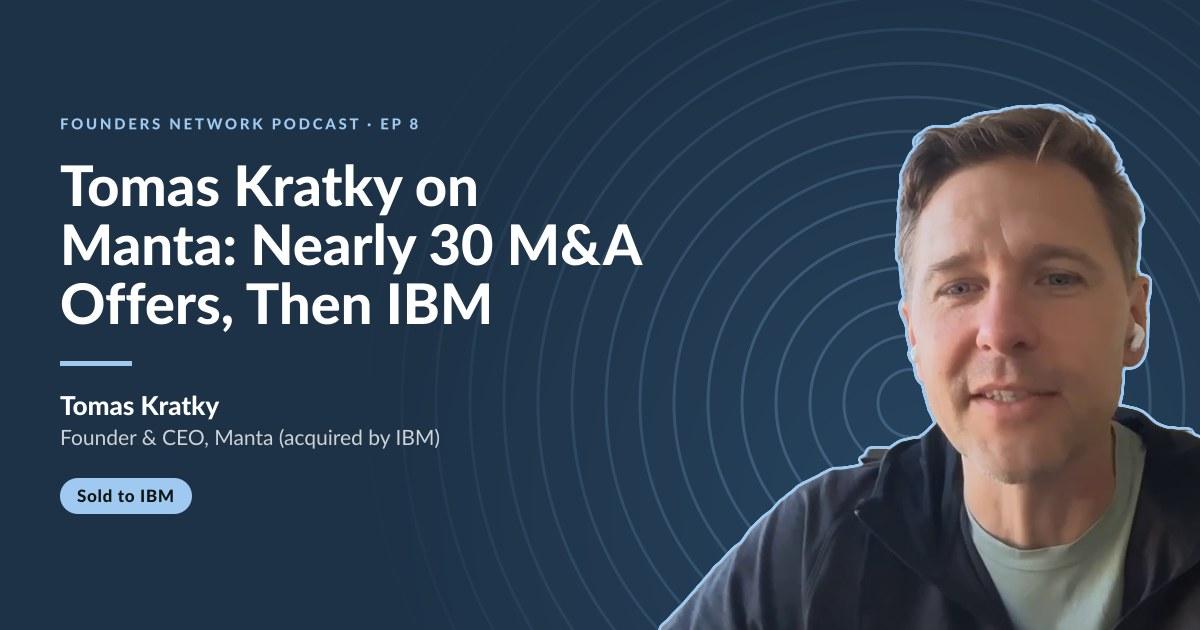
Tomas Kratky says most enterprise sales fail because founders will not answer a few plain questions honestly: who buys, who uses, and what else the buyer could spend the money on. Kratky is the founder and CEO of Manta, a data lineage platform that grew out of a consulting project in Prague. IBM acquired it in 2023, after close to 30 M&A offers.
Host Kevin Holmes, CEO of Founders Network, talked with Kratky on the episode about bootstrapping, venture funding, moving from Europe to the US and selling to large companies. Kratky has recently moved to the San Francisco Bay Area and now advises and invests in early-stage startups.
Key takeaways
- Manta was bootstrapped with profit from a software company Kratky and his friends already owned, and outside funding came much later.
- The worst cash crunch came shortly before the Series A, when large customers moved from paying in 30 days to paying in 200.
- Sales methods matter less than the discipline to answer a few basic questions honestly.
- Founders should do the early enterprise selling themselves, in person, before handing it to a hire.
- Venture money follows what is new, so a founder outside AI needs a plan for cash from other sources.
How Did Manta Start Without Venture Money?
Kratky used profit from a company he already ran. He and his friends had done a management buyout of a small Prague software house and grown it into one of the largest in the region, and that business let them put their own money into Manta in its early days. Outside funding from Credo came much later.
The idea itself came out of customer projects. The team built a few for different clients and noticed they had something in common. Kratky then ran a research project with two local universities and won a local competition, which sent him to Silicon Valley for a few months. He came back certain he would spin the product out into a company.
He then spent seven or eight years on the East Coast, mostly in New York, near the big finance and healthcare customers. That is where he learned to sell and to find product-market fit. Bessemer came in as the Series A investor after that. For more on the trade-offs, see bootstrapping versus fundraising.
What Happens When Your Startup Gets Close to Bankruptcy?
Kratky says Manta came close to bankruptcy several times, and the worst stretch was shortly before the Series A. COVID slowed most companies down, some customers churned, and invoices that used to be paid in 30 days were being paid in 200.
The company had about 60 people by then, so a missed payroll meant real consequences for many families. His contracts had the right language, but he says a small startup has little leverage over one of the largest financial institutions in the US. You keep asking for the money, and it is everything to you and nothing to them.
He had also made the situation harder. He was fixed on landing a top-tier investor such as Bessemer or Sequoia, had a very short list and no plan B, and at the low point he wondered whether that fixation had killed the company. Bessemer did invest. His summary was short: he is not capable of giving up, and the harder it gets, the more he pushes.
Why Do Enterprise Sales Fail?
Kratky says they fail because founders avoid honest answers. Frameworks and methodologies, in his view, only show you which questions to ask, and there are perhaps six or seven of them.
"It's actually the discipline to be honest and to truthfully answer those questions and not be afraid of the response."
The questions are about the buyer. Who signs, who actually uses the product, and who is your champion? Is your champion actually your champion? In a large company the data platform team may buy, business users may use, and a CTO, CDO or CFO may approve, each with different goals. He warns that you can sell to someone who values your benefits but never experiences them, because they only buy the software and then require others to use it.
He also asks founders what else the buyer could do with the money. A company may be able to do one big new thing in a year, such as a cloud migration or a rebuild of the analytics layer. If you are not part of that, you drop down the priority list however good your ROI looks. "Find those customers where you are the number one priority," he says, and sell to them.
He found the same honesty applies to his own product. He admits he was obsessed with why Manta was exceptional and did not pay enough attention to how customers saw it. For more on listening to buyers, see why customer feedback matters.
How Should Founders Sell to Large Companies?
Kratky's answer is to do it yourself, in person, all day. In New York he met as many people as possible, sending emails and LinkedIn messages and finding that people responded, partly because a founder is a different kind of visitor than a head of sales. He thinks a founder who sells to large companies over Zoom should find a better use of time, and that if you do not sell, nothing else matters.
His biggest mistake, made with no sales experience, was hiring a salesperson, letting them run and losing touch. The plan was that the salesperson would generate leads and he would close them. It did not work, it cost close to a year, and he realized Manta still had not reached product-market fit. An experienced salesperson can add structure on CRM, pricing and executive language, he says, but the founder should do most of the work until the model is proven.
When a prospect gives a vague reason, such as a governance initiative, he keeps asking. What is the exact problem? Was there a fine? Sometimes the honest answer is that a half-good tool the company already owns is enough to show a regulator, and there is no deal. If you present the questions as curiosity, he says, you will not offend anyone.
He also tells founders to live near their buyers. If your customers are manufacturing or energy companies, go where they are, even if that is Texas and not San Francisco.
Is Venture Capital the Only Way to Fund a Company?
No. Kratky says venture money tends to chase whatever is new, so a founder outside AI may find it harder to raise, and that has nothing to do with the quality of the product. For those founders, he says, the question is where cash comes from if not from a venture round.
He knows a few companies without a venture-style cap table that are growing and expanding into the US while beating better-funded competitors. He also pushes back on talk that SaaS is finished. SaaS is a way of delivering software, he says, and founders should be specific about what they mean, whether it is pricing or the product. Manta went through several rounds of pricing experiments and ended on usage-based pricing, and the team rewrote almost the whole code base at least twice.
Kevin added that venture capital is one kind of capital among several, including revenue. For the next stage, see Series A fundraising.
Should International Founders Move to the US?
For an enterprise B2B company, Kratky says yes, and early. The US has a common language, markets that are uniform compared with Europe, and most of the large banks, healthcare companies, telcos and technology companies. He makes exceptions for specialized fields, such as quantum, where a local ecosystem like Munich or Zurich may serve you better.
His reason is that the US is where you are pressed and tested. If you do that early, you are ready for the fight. If you arrive late, he says, you will be lazy and companies in the US will demolish you.
How Do You Sustain a Ten-Year Sprint?
Kratky counts about ten years on Manta from 2015, including his time at IBM, and he says speed was always what mattered. He recalls telling the team at an all-hands in 2016 that "this is a sprint with the length of a marathon". He believes in hard work and sacrifice, and he treats his own story as a sample of one.
The one thing he would protect is health. He compares a founder to an F1 driver who sleeps, eats, works and trains, and says he paid a price for neglecting that for a while. Talking to another founder, he adds, is almost like therapy, because at some point nobody else in your life understands what you are going through. See managing founder stress for more.
Frequently asked questions
What does Manta do?
Manta automatically analyzes a company's data environment to map how data moves and what depends on what. You can trace a number in a report back to its source, and use that for compliance reporting, safe changes and finding bugs.
How did Manta end up with IBM?
Because Manta worked with many parts of the data ecosystem, Kratky says it drew close to 30 M&A offers over the years. He accepted IBM's. He says he likes IBM and its engineers, and he stayed about a year and a half to learn enterprise sales.
What is Tomas Kratky doing now?
He advises a few startups closely, has backed about ten or eleven companies, and works with very small funds. His non-compete is ending, and he is looking at older industries such as manufacturing and energy.
If you're building a tech startup, request an invitation to Founders Network.