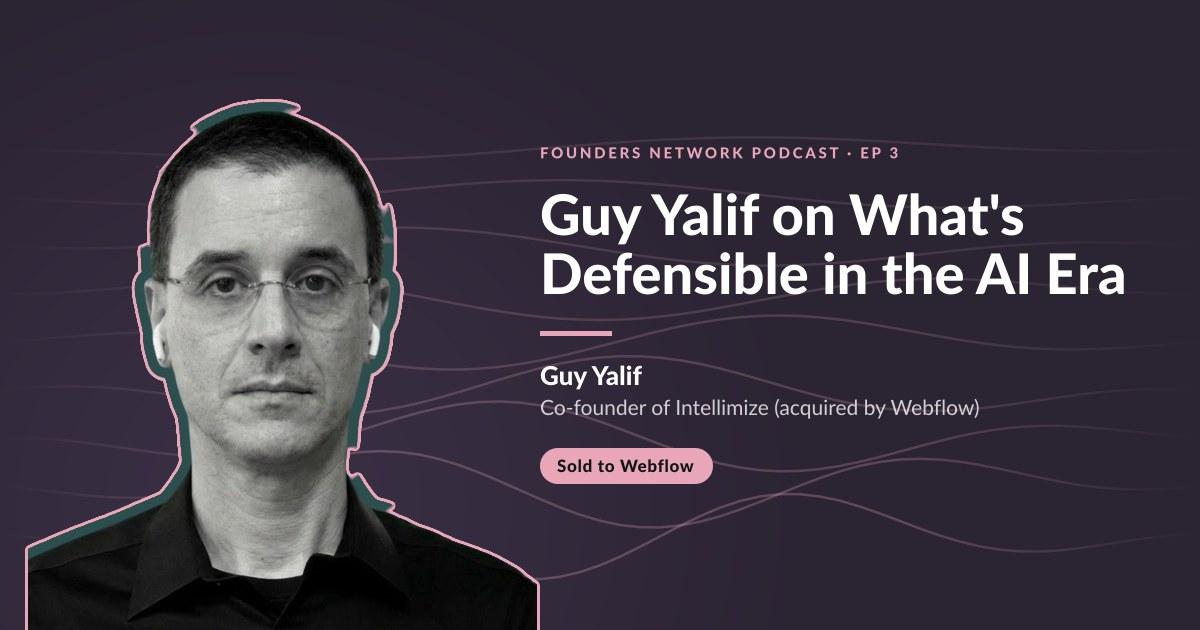
Guy Yalif, co-founder and CEO of Intellimize (acquired by Webflow in 2024), says that what stays defensible in the AI era, when a product is easy to copy, comes down to four things: brand, distribution, switching costs, and data. He joined Kevin Holmes, CEO of Founders Network, to talk about what to build, how to validate it, and why the fundamentals of the job haven't changed.
Yalif is now Webflow's chief evangelist. He previously led marketing at Twitter, Yahoo and BrightRoll, has been part of four exits, and started his career as an aerospace engineer.
Key takeaways
- Four moats: brand, distribution, switching costs and data stay defensible when a competitor can rebuild your product in a quarter or two.
- Pick your spot: build where the foundation model companies have little economic reason to go, and where you have founder-problem fit.
- Ask for money: about 15 customer conversations is a reasonable number in B2B, and the test is whether they'd pay a specific amount today.
- Optimize for learning: early revenue is proof people will pay, not the goal.
What stays defensible when anyone can build a product?
Yalif starts from a simple premise, which he laid out early in the episode:
"If you're in a world where the ability to create a product is not defensible on a shorter medium term timeframe, like what can you come up with that somebody else won't be able to build in the next quarter or two? It's a different world."
His answer is four assets. When Intellimize started, product IP was the defensible core. The team added the other assets later.
Brand
Yalif's example is OpenAI. Picture a world where every foundation model performs the same, and OpenAI would still arguably be the winner outside Google and Microsoft because of what it has done with its brand.
Distribution
Webflow partners with a couple thousand agencies, and Yalif says those relationships are hard to replicate. Kevin notes that distribution favors incumbents, and repeats the saying that first-time founders think about product while second-time founders think about distribution.
Switching costs
Technical switching costs are falling. Yalif says a CMS migration that once took a huge project can now be done with an MCP server, and Kevin describes replacing a CDN provider over a single evening after hitting a quota.
The human cost hasn't fallen the same way. Yalif tells a story from his own team: they chose one LLM over a possibly better one because everyone already had permission to use it and was used to it. In a larger organization, he says, that habit is real even when the technical cost has dropped.
Kevin points to an earlier podcast guest, Wade Foster of Zapier, who made a related point: founders are high agency and don't carry the politics and consensus-building that slow a bigger company down. Yalif's version is about risk. A founder can vibe-code a tool, get hacked, and fix it fast. A marketer at a larger company who does the same thing would probably be fired.
Data
The fourth asset is data. If people using your product leave behind a digital exhaust that is unique and valuable, that is hard for anyone else to match.
Where are foundation models less likely to compete?
Yalif adds two filters for choosing what to build. The first is to ask what isn't in the economic self-interest of the foundation model companies to train deeply on. As Yalif tells it, Anthropic has said it's going deep on enterprise coding, and OpenAI said it would do the same and go deep on medical. He suggests looking at the places they're less likely to find worth pursuing.
The second is unfair advantage. The investors he talks to are looking for founder-problem fit, even more than a unique way to solve the problem.
How do you validate an idea with 15 customer conversations?
Yalif's rule of thumb is to keep having customer conversations until you stop learning much. Fifteen is a reasonable number in B2B, he says, and probably more in B2C. There is nothing magical about it.
He starts with the customer's work and life: how does your work look today, what's great about it, what isn't, how are you evaluated, how do you get promoted, what makes you happy or unhappy at work. Only then does he describe a problem he's thinking of solving and ask how they react.
People will say something positive because they want to be nice. So he asks the question that matters: would you pay a specific amount for this today? He calls the distance between "that could be useful" and "I will pay for it right now" a huge one that first-time founders underappreciate. The trap is worse when you talk to friends. People your friends introduce you to, at arm's length, are a better test. When he asks, he says this first:
"Thank you. You cannot hurt my feelings. I actually value not wasting time on the wrong thing more."
Yalif still does this every day, after launch too, and puts it under setting strategy, one of the few things only a founder can do, alongside not running out of money, setting culture and setting the hiring bar.
The best advice he got during Intellimize's fundraising, which raised $52 million in total, came from another founder on a Sunday afternoon who had 15 minutes. The founder told him the pitch was bad and explained everything wrong with it. Yalif calls it a gift, because the people close to him weren't willing to say it. The takeaway is directness. Make it safe for people to tell you it isn't working.
How do you get from customer insight to revenue?
Yalif says there is no formula, but a few habits showed up for him. Keep running the next round of 15 conversations on finer parts of the problem. Early on you talk to the person who can write the check, later to the person who uses it every day. Over-serve your first customers and build personal relationships so they tell you what's wrong before they churn.
Early on, he says, you optimize for speed of learning against your biggest risk, not for revenue. Revenue matters because it shows people are willing to pay.
At Intellimize the risk was the machine learning, not the interface. Before leaving their jobs the founders spoke to about a hundred marketers. The first product "UI" was server logs that he and co-founder Brian put into Google Sheets, with AppleScript taking screenshots for PowerPoints. The first check came on day 90, and he recalled revenue at the seed round being around $75K.
Yalif also learned to write the code that modified web pages, because the team hadn't built a visual editor. He says it was one of the best strategic decisions the company made. He wrote several thousand variations himself, and because he only promised what he knew he could deliver, customers shared more and the team learned faster. Kevin compared it to the forward-deployed engineer model, and Yalif agreed.
Do you need co-founders, and should you split equity equally?
Asked about the solo founder narrative, Yalif says it depends on the individual. Capability isn't what worries him. Bouncing ideas off his two co-founders produced better results, and he needed the human interaction, because the job is as emotional as it is objective. He is curious whether AI thought partners can serve some of that purpose.
The three founders split equity and pay equally. Kevin cited Peter Walker's research at Carta showing that few founding teams split equity evenly, and Yalif said he had no idea it was that rare. When an investor offered him more equity after his vesting ended, he said they would divide it three ways. They stayed equal through the Webflow acquisition. He says the trust behind that is why it worked, and he would do it again.
On the loneliness of being CEO, Yalif says his co-founders spared him much of it. He also calls joining peer groups, including Founders Network, life-changing.
Is SEO dead in the AI era?
When Kevin asked for a growth myth to debunk, Yalif picked "SEO is dead." He said it's probably 95 to 97% of your traffic and conversions and the foundation for good answer engine optimization (AEO). He thinks AEO is under 10% for most companies but growing exponentially.
At Webflow, he says, 8% of self-serve signups came from LLM source traffic in the summer before the recording, and that traffic converted six times better than unbranded SEO. He also says each new channel, whether mobile or social, was supposed to kill SEO, and Google search has not gone down.
Closing advice from Yalif
He leaves founders with two points. The core job hasn't changed: do something for someone that delights them enough that they'll pay you for it. And know which game you're playing. The lifestyle or bootstrap game and the venture game (see bootstrapping vs. fundraising) have different stakeholders, and mixing them up causes problems.
For more on how to test demand early, see our guide to product-market fit, and on learning from founders who have done it before, our overview of startup mentorship. More episodes are on the podcast page.
Frequently asked questions
What makes a startup defensible when AI can copy the product?
Guy Yalif names four assets: brand, distribution, switching costs and data. Product IP still counts at the start, but if a competitor can rebuild your product in a quarter or two, these four are what keep customers with you.
How many customer conversations do you need to validate an idea?
Keep going until you stop learning much. Yalif says fifteen is a reasonable number in B2B and probably more in B2C. Ask whether they would pay a specific amount today, not whether the idea sounds useful, and talk to people at arm's length rather than friends.
Where can AI startups build without competing with foundation models?
Look where the model companies have little economic reason to train deeply. They have said they're going deep on enterprise coding and medical, so Yalif suggests the places they're less likely to find worth pursuing, ideally where you have founder-problem fit.
What should an early-stage startup optimize for before revenue?
Speed of learning against your biggest risk, Yalif says. Revenue counts as proof people will pay. At Intellimize the risk was the machine learning, so the first interface was server logs in Google Sheets.
Founders Network is a peer mentorship community for tech startup founders, and membership is by application. If you'd like to talk these questions through with other founders, request an invitation.