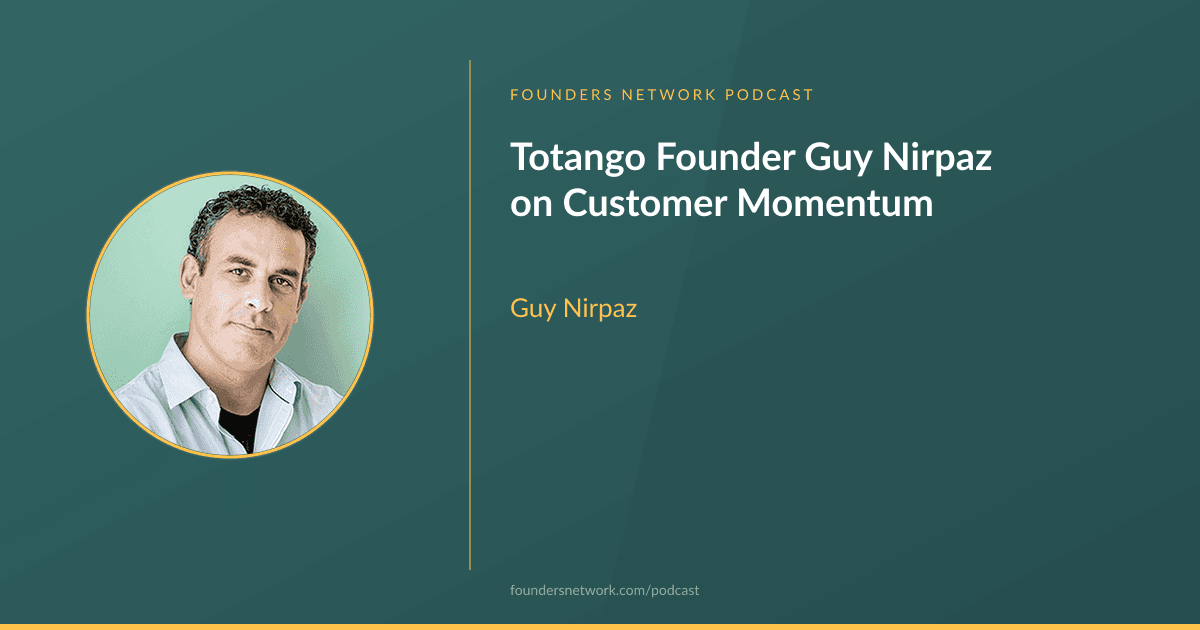
Guy Nirpaz's customer momentum loop is a repeating cycle: engage customers, learn from them, identify problems and opportunities, prioritize them, and ship a new version of your product, service, experience and pricing. The more loops you run, the faster you learn. Nirpaz founded Totango in 2010, helped create the customer success category, and now runs Perspective AI.
Host Kevin Holmes, CEO of Founders Network, introduced Nirpaz on the episode as the founder of Totango, which he scaled to 20 million users across 2 million businesses before an exit to private equity. Kevin cited $149 million raised across seven rounds. Nirpaz is also the author of Farm Don't Hunt, the book where Kevin first encountered him. The episode was recorded in July 2026.
Key takeaways
- Your role will change faster than you expect. Plan to add partners and teammates when the problems change.
- Confidence comes from trusting your ability to work through problems, not from having the answer up front.
- Ten-year-old lessons deserve a second look, particularly on go-to-market.
- Shorter loops with customers give you more chances to learn each year.
- Keep a direct line to customers, without summaries in between.
Why Start Over After an Exit?
After the sale to private equity, Nirpaz stayed on as CEO for another year, then parted ways and did some board work. Very quickly he got bored.
He also learned he isn't a good advisor. When people bring him a problem, he says, he wants to jump in and help solve it, and he describes himself as very opinionated. "I might as well find a problem, go solve it, and enjoy the path."
The ChatGPT moment gave him the problem. He realized the work they started at Totango wasn't finished. That work is customer centricity and customer obsession, which most companies can't execute or sustain for long. He sees AI as a new form factor for engaging customers, and a way to solve the problem for good.
The second reason is personal. He says you find yourself by going through the founder journey, and the challenges are a chance to learn what you like, what you don't, and where you need to improve.
Why Does a Founder's Job Keep Changing?
Nirpaz says an early-stage CEO role isn't a job you can write a description for. He used to joke that your job is different every year, and he believes it's true. If you can't morph into the new job, you struggle. At some very fast-growing companies right now, he says, it changes every two weeks.
He compares it to problem solving, closer to a private detective's job than a fixed role.
How do you define the problem? What are we dealing with? What options do we have, who can do what, and is it working? The problems differ when you're still figuring out the product and the market compared with when you're growing beyond the markets you're in. That's why you sometimes need additional partners or team members.
He doesn't think learning is a matter of consuming more and getting better. Applying go-to-market strategies from 10 years ago won't necessarily work today, he says, and it takes humility and constantly filling the gap in what you don't know.
How Do Founders Live With Uncertainty?
Nirpaz's daughter, who is in her early 20s, asked him a few days before the recording how he kept going without knowing whether it would work. Guy Nirpaz's answer was about conviction in yourself, not in the solution.
"What you learn over time is to believe in yourself more and more, where I don't know what the solution is gonna be, because I don't know what the problems are gonna be, but I have strong conviction that I will be able to overcome a lot of it."
He describes the stretch where you don't know what the problem is, then you know the problem but have no solution, then you try solutions that don't work. You have to live with that uncertainty, he jokes, without gaining forty kilos.
On managing founder stress, he says he did not do well during the Totango days, with an enterprise business, international travel and a lot of stress. These days he wears a ring that keeps a daily record, which he uses to see the effect on mental performance and creativity, and he swims four or five times a week, usually about 2,000 meters. He says that doesn't cost him time, because his performance is better.
What Is the Customer Momentum Loop?
Nirpaz says customers are a key business domain that isn't well addressed. They are a relationship problem, not a transactional one, and a long-term one. He mentions his wife's yoga and Pilates business, where she has customers of ten, fifteen, twenty years. He wants every business to have that kind of relationship, as Amazon aspires to with customer obsession.
His framework for it is the customer momentum loop. He describes customer success as anchored around the team, and customer experience as anchored around the dashboard or survey. He calls customer momentum the operating model for customer obsession, a principle he credits to Jeff Bezos.
When a company has customer momentum, he says, you see pull from the market. Products like Claude Code or Cursor market and sell very little because the product matches what customers need, and customers convince one another to buy more. When it's missing, there is friction everywhere: aggressive marketing, high acquisition cost, hard onboarding, and every renewal is a battle.
The loop is how you find alignment, grow it and keep it. Engage customers, learn from them, identify problems and opportunities, prioritize and sequence them, and create a new version of your product, service, experience and pricing. Then go back to the customers. He says alignment is never 100%, so your top three priorities should change constantly, every month or quarter.
He started thinking in loops as head of engineering about 20 years ago, implementing Scrum. At Totango the loops were win-loss and churn analysis. With AI the loops get shorter, and the more loops you run the faster you learn. A loop every month is 12 learning opportunities a year, he notes, and a loop every day is 365.
Kevin added a caution. You can end up in an echo chamber with AI and get misled, so the loops should be anchored on customers.
How Do You Stay Close to Customers as You Scale?
Totango grew to about 200 employees at its peak. Kevin asked how Nirpaz stayed connected to customers. His answer was a habit: on slow Fridays he would go to the customer success team and ask what happened that week and what they learned. In one example, a customer's project slipped by a month because a 45-minute training session wasn't long enough to finish a configuration flow.
He says it's unrealistic to be close to every customer, which is part of the reason for Perspective AI. He points to Nvidia CEO Jensen Huang, who he says has over 70 direct reports and asks for raw information instead of summaries. The principle is to stay connected to where the truth is without summarization in the way.
Nirpaz also connects this to AI itself. AI works well when it has context, meaning the information that matters, not everything that happened. A leader needs the same thing to make decisions.
How Should Founders Read the AI Hype Cycle?
Asked about the hype cycle, Nirpaz says the absolute truths pushed on social media should be taken with a grain of salt. First it was assistants, then agents, and now agents are a new word for software. He thinks AI is real, but starts from a different question: as long as humans make the purchasing decisions, what is the market looking for? Everyone can cook, he points out, but people still go to restaurants.
He also warns against comparing today's productivity with ten years ago. You aren't competing with the companies of ten years ago, he says, you're competing with companies that have the same tools you do today. His answer is first-principles thinking, and he says first principles start with the customer. And when everyone is building the same thing, doing the opposite has a higher potential for alpha.
What Does Perspective AI Do?
Perspective AI builds AI-powered CX agents. Nirpaz's thesis is that AI built on organizational data is useful but misses a data set that sits in customers' heads, which is fresh and constantly changing. Perspective is built to capture it. In his framing, what used to be a survey is now an agent.
It's for chief customer officers and customer success and customer experience teams, and also for product people and founders who want to turn input from potential or existing customers and partners into decisions. Nirpaz says customers range from one-person companies to companies of about a thousand employees, with larger enterprises starting now.
Frequently asked questions
What are the steps in the customer momentum loop?
Engage customers, learn from them, identify problems and opportunities, prioritize and sequence them, and create a new version of your product, service, experience and pricing. Then go back to the customers and run it again.
How often should you run a customer learning loop?
As often as you can act on what you learn. Nirpaz notes that a loop every month gives you 12 learning opportunities a year and a loop every day gives you 365. Anchor the loops on customers so AI doesn't turn them into an echo chamber.
How can a CEO stay close to customers as the company grows?
Build a habit that puts raw customer information in front of you. At Totango, which peaked at about 200 employees, Nirpaz spent slow Fridays asking the customer success team what happened that week and what they learned.
What is Perspective AI?
Perspective AI is Guy Nirpaz's current company. It builds AI-powered CX agents that capture what customers are thinking, for customer success, customer experience and product teams and for founders.
You can hear the full conversation with Guy Nirpaz on the podcast. For more on learning from founders who have been through it, see our overview of startup mentorship.
Founders Network is a peer mentorship community for tech startup founders, and membership is by application. If you'd like to work through these questions with other founders, request an invitation.