Wade Foster0:00
Claude Code, that feels like a bicycle for the mind. I feel like I got the wind at my back. I'm just sailing here. And even when we have problems, it's like, no biggie, let's just try again. And it's just kind of off to the races. It's incredible.
Kevin Holmes0:15
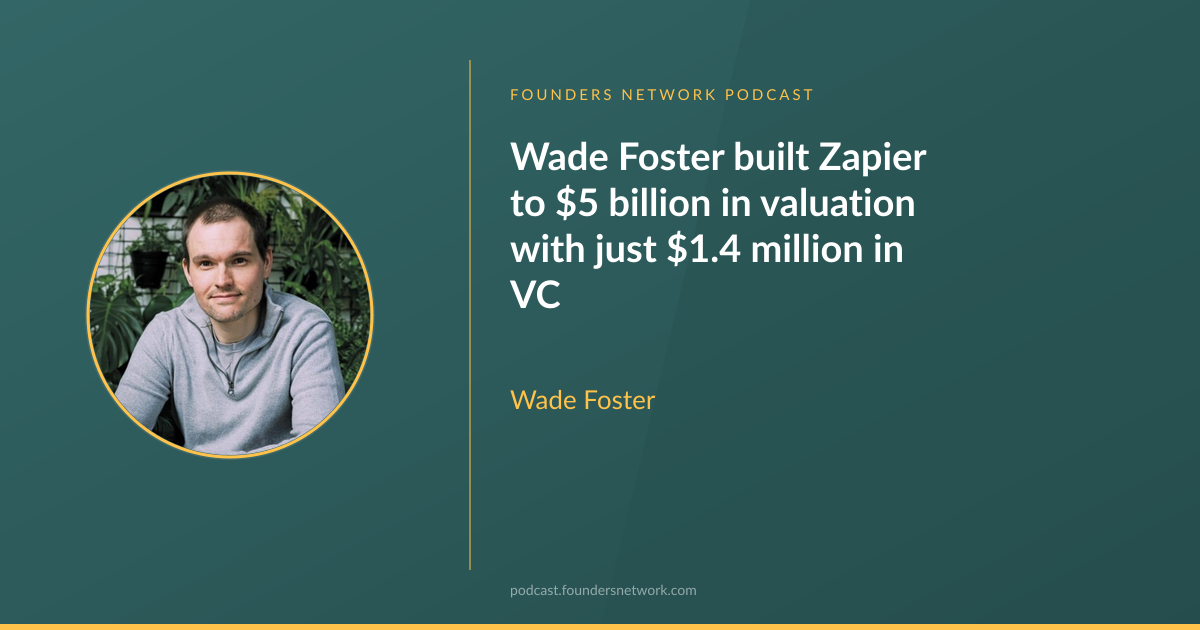
Welcome to the Founders Network podcast where you get the real story, not the highlight reel. You'll hear the decisions, the doubts and the messy middle of building something that matters. Today, you're going to hear my conversation with Wade Foster, who started Zapier in his Missouri bedroom with two co-founders, raised just 1.4 million in venture capital and grew it into a $5 billion company. He's been building Zapier for almost 15 years now and he's still at it. This is one of the best product market fit stories I've heard. You'll hear the early days, including the wait someone will actually pay for this moment, the startup week and sprint, and two years of building nights and weekends before going full-time. This is a story about hard work, scrappiness, and sticking with it when nobody's paying attention. We got into finding the right co-founders, why don't hire until it hurts is a survival tactic, and how product market fit often starts as a tiny signal. Then we fast-forwarded to agents, context windows, vibe coding, and what the next wave of builders will win on. And if you're vibe coding, check out Zapier MCP. What I loved about this conversation is that Wade talked openly about the people who helped him along the way. That's what Founders Network is all about, lifelong success through peer mentorship. Wade sharing his story with our community is reciprocity in action. Wade's not Ironman. He figured it out one day at a time with help from the people around him. If he can do it, so can you. So keep on building, never give up. Wade, thank you for doing this and enjoy the conversation. So where do we begin? Tell us about kind of your origins. I know you're from Missouri.
Wade Foster1:50
Yeah, so I grew up in central Missouri, Jefferson City, Missouri, kind of a slow, old school government city. It's the capital of Missouri. Not a lot changes there. It's not exactly like a pinnacle of industry. The big employers are the state government, the school system, the hospital system, things like that. It's not like there's a lot of commerce or industry going on there. And so I kind of had what I felt like was a pretty just normal, you know, middle class, middle of the country childhood upbringing. And, you know, ended up going to school at University of Missouri 30 miles north. And, you know, not really very certain of like, what I wanted to do. Entrepreneurship was not exactly on my radar. But, you know, I knew I liked math and science. And so I, you know, went to school to get it to get an engineering degree. And, you know, during school was the great financial crisis. And I was a junior when that happened. I was always a good student. But I remember that summer going to try and get an internship, a job, et cetera, and just nobody would hire anyone. Didn't matter how good of a student you were. It didn't matter if you had good grades or anything like that. They just didn't want anything to do unless you were, you know, Exceptional in some degree. I never quite figured out exactly what it was, but it was not me. I'll tell you that. ~
Kevin Holmes3:13
Yeah, I finished my undergrad in 01, right after bubble burst. And I finished my
Wade Foster3:17
Alright, let's see if we get some...
Kevin Holmes3:18
MBA in 29, 2010. So yes, I know this story.
Wade Foster3:21
I'm sure you can relate then. ~ So, you know, I, but at the time, you know, I was starting to, you know, like Facebook had come out, like I was starting to be like more online, you know, and I, kind of came across this idea of, you know, you can build a website and you can put like AdWords on it and like, maybe you can make money on the internet that way. Like, that's kind of interesting. So there's like kind of some mathy stuff around marketing that was like interesting. And lo and behold, I found this tiny little startup in Columbia, Missouri that was run by a professor at the university. They were looking for somebody to do marketing. I don't think they knew what marketing meant, which was great for me because they didn't know how to evaluate if you were good at marketing or not. And for whatever reason, they thought, know, hey, let's take a bet on this kid. And, you know, I got to work out of the professor's house. There was like seven of us. I was like, oh my gosh, this is nuts. You can just like put a thing on the internet and someone halfway across the world can find it and pay you money for it. Like that's real. That's a real thing you can do. know, the act of building websites, building software, marketing software, the whole thing was just very, very interesting to me. And so I started to learn to code, learn to design, learn to do all this stuff. I'm not sure I ever got particularly good at any of it, but I just loved all of it and I was wanting to get good at it. And from that, I ended up reaching out to... an acquaintance of mine that was at, I had known through the University of Missouri jazz program. So both him and I played music, we played jazz. I played sax, he played bass and guitar. And he was the only person on town that I knew that was not only building software, but was also trying to build companies. Like he had built some sites, he built some stuff, he was making money, et cetera. And I was like, hey, like, I want to learn from you. Like, show me what you're doing. I want to like teach me this stuff. And the trade was they needed a saxophone player for their band. So And he says, yeah, I'll do that if you come play my quartet. And so I was like, sure, sign me up. Let's go do it. And so that started what's now been a lifelong friendship between Brian and I, where we just spent all the time gigging around town, playing music, building side projects, building sites. He brought me over to the, there was a mortgage company in town that was one of the fastest growing companies in Columbia. We started working there together. And one day he, messaged me the idea for what eventually became Zapier, and the rest, as they say, is history.
Kevin Holmes5:44
That's so cool. Yeah. How do you find your co-founder? That's always a like a perennial question for folks. And then how do you persuade them to join you? Right. And so there's this technical academic term of bricolage, right? Kind of martial resources you don't control or direct, like trading saxophone for the band is a great example
Wade Foster6:02
Hahaha
Kevin Holmes6:04
of like, okay, cool. I'll do that. And then you help me with the startup and then it builds and grows into something from there.
Wade Foster6:10
Yeah, I mean, think there's just a lot to be said around spending time with interesting people who are doing things that you think are interesting too. And for a lot of folks, I think that probably happens at work. You're in and around people who are working on the same things as you, but what are you doing outside of work? Where are you spending your time? If all you're doing is just sitting around watching football games, which don't get me wrong, I like watching football games too, you're probably not. increasing the surface area of people that you're meeting and doing interesting things and working on interesting things with them.
Kevin Holmes6:40
Yeah, this is one of the things I just mentioned to the new cohort we on boarded for founders this morning was like, we've been doing this 15 years. So, so many people are like, I'm looking for a technical co-founder. And I told them like, look, what I see, I've seen play out is in three to five years, seven years, those people have shut down their startups. You shut down your startup and now they're teaming up with each other to start the new thing. And that's a dividend that comes from investing in these relationships. Or as you put it, creating that service area to interact with interesting people. love that. Very cool. So sort of Midwest origin story, very happenstance in that magic moment of the internet of like, holy cow, our biggest customers in Australia. These are more magic moments happening now around generative AI. we keep living through these moments. But as an entrepreneur, it's just like, especially a tech entrepreneur, it's such a special thing to live through these times. But before we get to where we are, today with generative AI. want to kind of work our way there with your story. So you guys are working together at this mortgage company and then you tell us kind of where you went from there to get to where you are
Wade Foster7:47
so we're at the mortgage company and Brian, you know, he's, we're using a lot of the early software as a service platforms, you know, we're fans of like Mailchimp and Basecamp and things like that. So we're just kinda, we're all just kinda poking around and seeing what they're doing. And Brian noticed this trend, which if you would go to their community forums and look through common requests that would pop up almost everywhere, you would see the same flavor of question, which was, when will you integrate with X? And the threads always followed a very similar format. It would be a bunch of customers saying, plus one, me too, I really want this. And then eventually, there would be a product manager that would chime in and say, hey, folks, thanks for the suggestion. We really appreciate the feedback. We're going to take a look at this and see what we can do. Which if you worked inside these companies, you know is code for probably not going to happen. He messages me, and he's like, hey, I think we can make a really simple way for business users, non-technical folks, to build integrations between the SaaS that they're using. And I jumped at this because my day job, I'm working with the Marketo API, doing email marketing. And I'm not a particularly good engineer at this point, never was. But the Marketo API is this old school Soap, WSDL, API, the documentation is in a PDF. Needless to say, I'm not having a very good time. And so if the thing that Brian was talking about existed, I'd be like, I'd just use that. That would be a better path for us. And so it just so happened that there was a startup weekend that was coming up around the corner. And Brian took the idea to that event. We teamed up with Mike, our other co-founder. And we built the first prototype of the product in 54 hours that weekend. Had a ton of fun. They had some prizes and stuff. We ended up winning the competition. But after the weekend, we're like, well, do we want to keep doing this? What do you want to do? And our perspective was like, this was a lot of fun. Let's just keep working on it. Now, we're in central Missouri, mind you. So we're not in situation where you raise you million dollar seed round, you quit your jobs, you just go all in and make this thing happen. That's kind of not like the environment we're in. And so we just looked at each other and said, OK, we'll just do this nights and weekends. So Brian and I have jobs, Mike's still in school. We would, you know, many nights we just meet up at get takeout Chinese, meet up at six o'clock, six thirty or whatever. And then we'd work till midnight one, two a.m. on Zapier And then we kind of rinse, wash and repeat for months, honestly, is kind of the approach until we had a prototype ready that we felt we could launch.
Kevin Holmes10:33
So cool. Was it a startup weekend or was it just like, yeah, it was. Yeah, was a success story. Yeah.
Wade Foster10:35
Yeah, was one of the official ones. think the Techstars owns it now, I want to say.
Kevin Holmes10:43
Yeah, I haven't seen it in years, it was a...
Wade Foster10:45
Mm-hmm.
Kevin Holmes10:47
I'm glad there's a success story for me, I'll say that. And in this kind of like idea of like, don't hire until it hurts, or, you know, it's kind of baked into your story, like you guys kept your day jobs and built until you could actually leave and go full time.
Wade Foster11:06
Yeah, well, think constraints breed a lot of creativity, and they act as a forcing function to really understand your stuff. I see a lot of founders that will hire really fast, thinking, I need more people to execute on my idea. And what happens is, when you hire all those people, you actually don't learn as fast. When you are forced to do the whole business, build the product, sell the product, market the product, support the product, et cetera, you really understand what makes it special and what makes it click. And then once you understand it, it makes it more obvious where you could use people to help grow the business and help it be more successful. I think I see a lot of folks get that equation backwards where they think I'm going to bring in people to build the business. And I'm like, well, you build the business. You bring in people to scale what you know about the business. But it's real tempting. Companies are hard. All this stuff is hard. And you're like, well, shoot, if I just had one magical person who could come in and handle this, that, or the other, then everything would be different. And generally, I don't find that to be true. I find the magical person is it's you, your co-founder. You are the people that have to bring this idea to life. have to will it to existence.
Kevin Holmes12:26
And so what was that moment when you had the day job and you're working the nights and weekends on Zapier, what was, and this ties into the hiring part too, but like even in your own narrative, what was the point where you said, okay, we're gonna go full time on the day job? Like was there a, in retrospect,
Wade Foster12:42
Yeah. Well, I ended up going full-time three, four months in. And, you know, I had my boss at the day job noticed that, you know, perhaps I was a little sleepy during the day and not exactly performing to the highest of my abilities. And so he had came in and was like, hey, Wade, like, you know, he's the owner of the company. He's like, look, you know, if your heart's set on this thing, like... you should go do that thing. So I kind of got a little nudge from him, which was helpful in hindsight. And then we ended up applying to YC, got accepted into YC for the Summer 12 batch. And so Brian and Mike went full time just before that. So that was kind of the impetus for going full time, was we now had like a little bit of money to be able to...
Kevin Holmes13:32
Where were you on like traction at that moment?
Wade Foster13:35
You know, when we got, so we applied to YC twice. First time was right after startup weekend. We got straight rejected because we didn't have anything except for very bare bones prototype. Six months later, we applied again. This time we had about 10,000 people on a launch list. We had a thousand people who had paid us money to get access to the beta. And in that a thousand people, we had a number of YC companies who, when we went to go apply again, we just said, Hey, like, you know, If you like our stuff, could you recommend us? Could you advice on the application? you just kind of guide us through and help us do a good job of this? And I think that probably helped our odds. That plus like we just shown a lot of progress. Like the first time around were three random people in the middle of the country. This time it's six months of progress. It's like, oh, these people will do what they say they will do.
Kevin Holmes14:26
And you mentioned wanting to sort of like revenue fund and be scrappy and the sort of ethos and not take venture capital maybe was a bias in there as well of like hiring people to do the thing but YC maybe was a different calculus. What was that decision like for you? Like why did you guys choose to raise money?
Wade Foster14:41
Yeah, YC always felt a little different. big fans of Paul Graham, his essays, read Hacker News a lot. It didn't feel like traditional venture capital to us. It felt like just a different beast. And we did feel like one way YC could help us was a little bit of a badge of approval because the product we were building required so many integrations. with people that were based in the Bay Area. And now many of these folks had open APIs and good documentation and we could just go use those anywhere in the world. But there were some companies, some larger ones that had red tape and bureaucracy and you kind of had to like prove yourself a little bit. And we were like, man, it'd be nice if there was somebody who could vouch for us and say, hey, like these folks are legit. And that ended up actually playing out. As soon as we got accepted in, I remember shooting PG in email and saying, hey, we're stuck on this random big tech company everyone has heard of. And he fired off an email. And 24 hours later, yeah.
Kevin Holmes15:45
Yeah, so was a credibility gap in closing one of these partners and the business was really closing these partners, right? Yeah. Interesting. Yeah. And so, the way, if IFTTT was an early member of FN at that time and went pure consumer side. And so it's interesting to see, and I've been a user of Zapier ever since then as well. So it's been interesting to
Wade Foster16:07
Mm-hmm.
Kevin Holmes16:08
see the different approaches to go to market. and they had, and recent provide that sort of credential, right? But that credibility gap is a big, it's a big thing for early stage startups,
Wade Foster16:18
Mm-hmm.
Kevin Holmes16:18
right? And how do you, especially coming from Missouri,
Wade Foster16:21
I think that that was what was where YC was probably what we were originally viewing as the value of YC was that. I think the second thing that we got, which we didn't necessarily totally understand coming in, was the focus. YC does a really good job, at least at the time, I assume they still do, of basically getting you to not do anything else but focus on your company. think a lot of founders show up with sort of preconceived notions in their head of like what a good founder looks like. And I remember the first, you know, kickoff, PG says, you should do three things all summer. You should write code, you should talk to users, and you should exercise. And our joke was we always said we exercised on day one and then we wrote code and talked to users the rest of the summer. But I think that's like very... It's exceptional advice because so many people get caught up with this event or this social media or fundraising or hiring or all these other things that maybe are important in time. at the stage, the early stages, you got to build a product and you got to get customers. There is nothing else. And so YC put us in an apartment. Well, they didn't put us in apartment. They make you go to the apartment. ~
Kevin Holmes17:39
Thanks
Wade Foster17:39
in South Bay where there's nothing going on. And so all summer, basically, you know, from the moment we woke up to the moment we went to bed, we were just sitting in a two bedroom apartment hacking away on this thing. That was all.
Kevin Holmes17:52
That's awesome. Yeah, focus, the power of focus and hard work too.
Wade Foster17:57
spot on.
Kevin Holmes17:58
And okay, so, and then you're talking to customers and you have a story about like customer product hard to fit where you kind of stumbled upon it. every early stage founder is looking for this. when I look at for FN, we have a fund, a small fund that we invest in. Member companies and lot of the LPs are founders of Exit. Jeremy Clark is one that from Formstack, you may know from Midwest also. And you hear his story, he launched on Zapier, one of the very first forum software on Zapier. It's just this lightning in a bottle distribution moment. We have other LPs in the fund who like were the very first game on Steam and gaming went to the cloud, right? And so you see these like these stories of the startups that find that product market fit, but it's also a story of distribution as well. was wondering if you could kind of share the story of Zapier and like, how did you, know, how did you, did you have a systematic process for finding it? Was it just what you talked about, talking to customers and
Wade Foster18:52
Yeah!
Kevin Holmes18:53
yeah, tell, tell like, share with founders like how they might go about based on your experience uncovering
Wade Foster18:58
Well...
Kevin Holmes18:59
that product market fit. and getting that sort of, just two questions, getting that distribution.
Wade Foster19:02
I think, yeah, I think the thing to go back to was Brian's original insight, which is there's these forums where people are saying, when are you going to integrate with X? And so what we started to do was drop comments in those forums. We'd say, hey, we're working on a project. Of course, you can use the APIs. If you know how to code, you can go build this stuff directly on your own. But if not, I got a project I'm working on. Try and solve this problem. It'll integrate this and that. Reach out, let me know. And every time we drop a comment, we get three, four people that would reach out. And of the three, four, half of them would be like, yes, I want this. I really need this. So it's not like you're getting a huge amount of volume out of this. But look, at this stage, you don't need volume. You just need anybody to care at all about what you're working on. And the fact that half of them are like doing somersaults and backflips. That was pretty fascinating. And I remember our first customer, Andrew Warner, runs his podcast, Migsurgy. remember reaching out to him and then I would, for, I, I, Andrew was the first person I did this with, but I did it with, you know, a ton of people in this, in that first year. I'd get on Skype, Skype at the time and help them set up their first Zap And I remember watching, foolishly expecting Andrew to just be able to go build his first one without any help. And I remember watching him try to set this up. And he's just struggling. And it's not his fault. The product is just not very good right now. It is a prototype of a prototype. But we get to the end. We set up this Zap And we go to test it. He's taken a WooFoo form submission. And he's putting the subscribers into AWeber, which was his email marketing tool at the time. So we went and test it. We submitted to WooFoo. We went and refreshed in AWeber. Hey, is there a contact in there? Sure enough, it works. And he goes, Wade this is incredible. Like, where do I send you money? I want to be a customer. And we didn't have a bank account. We didn't have any of this stuff yet. so like on the fly, I'm like, ah, here's my personal PayPal account. You could send me a hundred bucks. So was like making up something on the spot. But I remember that that experience was so different than the startup I'd mentioned before, you the one with the professor's house where There our products were like very slick, well engineered, design was amazing, usability was good. Man, nobody, like I thought I was just bad at sales, bad at marketing, bad at doing this, which maybe at the time that's true, but nothing seemed to work. And with Zapier, it felt like the exact opposite. The product was a prototype of a prototype and the first reaction was, where do I pay you? But anywho, like the...
Kevin Holmes21:47
Yeah. No, is what everybody needs to hear in the early startup stages.
Wade Foster21:53
Totally. The process was then just rinse, wash, and repeat. It's like, drop those comments in, take the handful of inbound that comes, jump on Skype, watch them try and set up his Zaps If we don't support the app that they've got, great, build the app that they're wanting. And every time we'd watch people on Skype, just take a lot of notes. This part of the product isn't good. This part of the product is confusing. This part of the product tripped somebody up. Okay, how do we go smooth that over? How do we make that better? How do we make it easier to understand these things? And you know, we just did that for months, honestly, until we got to a point where it was like, okay, people are sort of finding their way through this without my help anymore. I'm finding that I don't have to course correct or point certain things out to them. So then it was like, well, let's just see if people can do this on their own. And we kind of let it be a little more self-serve at that point in time. And then honestly, we benefited a lot from, you know, Gary Tahn now runs YC. He was one of the first people we did office hours with. And he was like, when are you guys going to launch? we're like, well, we're not ready yet. We think we still got part of the da. And we just kind of explained where we were in this process to him. And he was like, y'all need to launch. You're ready. And so, you know, even still, we kind of needed that kick in the pants to go put ourselves out there and say, hey, let's go see what the. public reaction is to this thing.
Kevin Holmes23:17
And that's a common failure mode too is like, yeah, ⁓
Wade Foster23:21
Polish polish polish, yep.
Kevin Holmes23:22
yeah, just if you're not embarrassed by the first version, then you wait until. But how many, getting back to this process, because I want founders to have this takeaway from this anecdote. How many conversations do you have and you're doing this ride along on Skype? Like in retrospect, how many could you've gotten away with to get it done? And of course, it all starts with, it happened to be a forum, It all starts with uncovering some demand, right? And then building a VPN and getting, doing the right along and figuring out usability and these types of things. But what would be some like, if we're gonna give a guideline to founders that just based on your experience.
Wade Foster23:58
You know, I think you want to hear from your customers that... like the anti-pattern is people are being nice to you. "This is cool. I like what you're doing here. Yeah, that's interesting." And that's kind of, That's a real danger zone because they're being polite, but that politeness doesn't really help you out. you really, The kind thing, the thing you really want to hear is like, "Hey, Wade. I hate this, you're wasting your time. I would never buy this." And yeah, that burns for a moment. But at least I didn't waste six months or 12 months or years of my life working on a thing that nobody matters. But humans aren't wired that way. Humans are wired to let you down gently. And that gentle letdown comes in the form of, "Cool thing you're working on there, Wade. That's cool. It's interesting!" et cetera. And so you do really have to hold this like skepticism and optimism in your head at the same time. And the best way to do that is to just like look and see, okay, someone set this up. Are they still using it? A week later, they still use it? A month later? Or were they just being nice to you? And if they're still using it, all alright, kind of onto something. And look, you don't need everybody you talk to to be successful. In fact, in the early days, probably most people won't because the product probably is not very good yet. But as you start to get 1, 2, 4, 8 people who are like really in love with it, then you go back to those people and say, "Why do you love this so much? You're the only people that love this thing. Why is this so valued to you?" And like really try and tease out of them, what is it about them? What problem are they solving with your thing? And once you understand that, then you're like, okay, I'm going to double down on that. Like, how do I get more people like them? How do I make this problem more obvious to folks in the market so I can pull in people that look like them, et cetera, over time? And you just kind of keep this product-market fit as the center of the bullseye. You're continuing to just navigate your way into the very center of it. And look, you don't always... It always sounds so nice when I talk about this stuff looking backwards. But you know, I'm 14, 15 years in, I still feel like we're searching for the center of the bullseye. Yeah, I still feel like I'm like, man, you know, there's something that's like not quite, we don't quite have it.
Kevin Holmes26:29
Yeah, yeah, yeah. Well, let's get there because I think tech is always changing and we're in the middle of a seismic shift, right? And so I'm really curious to hear about your thoughts on that. But I want to kind of carry the through line of our narrative. You're in this discovery phase and you're having dozens, 40, 50 conversations. don't know how many, you know, and Gary says, get this thing to market, call the bug a feature and ship it. And then what does it look, tell us about the story of growth from there and the narrative there. carry us through to like where we are today.
Wade Foster27:01
Yeah, well, yeah, I think the simple observation we had pretty early on was that folks are already looking for integrations. They knew they needed to connect this and that. That's why they're asking stuff in the forums. And if you would go do a Google search for various integrations at the time, say you look for like Zendesk Jira integration, or if you look for QuickBooks Salesforce integration or things like that. The landing page results were like a desert. There was just like nothing in there. You'd get like a pastebin URL that has like, you know, somebody's random script that they've abandoned long ago.
Kevin Holmes27:39
I remember making these searches and then eventually they were all Zapier pages.
Wade Foster27:44
Well, yeah, we were just like, well, people are looking for these searches. What they're looking for is they want to plug and play integration. They don't want to have to go sift through all this stuff. So we just want to have a nice looking landing page that looks like a product that you can click a Try Now button and then drops you into product that helps you connect these tools up. Let's just give that to them. And so we quickly realized that The way to grow was to just make these landing pages. And then the way to get more landing pages is to have more integrations. So the bottleneck for us was, great, build integrations. Build the next one, build the next one, build the next one. So our approach, the first 50 plus, we were just heads down building as many integrations as we could. Some combination of our own intuition around what was possible, some public signals around traffic and things like that to help us guide what we thought could be interesting. And then we kind of got to a bit of an interesting inflection point where YCE has Demo Day. And the advice is you want to do something impressive for Demo Day. Do something that puts a big number on the board. And we knew the thing for us is more integration is going to lead to growth, full stop. We thought, well, for demo day, there's kind of two approaches. One, let's just keep cranking on integrations. Like, that's the fastest, easiest way for us to get more users, because we'll have more landing pages, and it'll just kind of get this fly while humming. Or we could try something a little more risky. We could go build a developer platform that made it easy for other people to build integrations. But. Most developer platforms don't work. Even for very popular products out there, if you go look at how many integrations they have, what their developer platform looks like, most of them is pretty small. And most of the ones that they do have are first party. They had to build them themselves. It's pretty rare when you get Slack or Salesforce or Shopify or MailChimp that have these breakout... ecosystem where everyone builds an integration to them. And the reality is they're the exception to the rule. They're not the rule. They get all the users, and so everyone builds to them. And no one wants to build to number two or number three in the space. So even if you're a really good company, you're probably not going to get people building integrations to you. So we're an integration company. We're pretty keenly aware that most developer platforms don't work. and by the way, we don't have any users. It's know, doubly unlikely that our version of an integration platform is going to work. But, you know, it might work for us, right? So, know, Brian builds the first version of this thing in two weeks. And we actually, we'd had a number of people reach out and ask for, you know, why it wasn't through an integration. I remember actually Aaron from Box had pinged us at like 2 AM on a Saturday. He's why isn't Box on Zapier? It's like, well, it's because there's three people at this company. And like, of course Box should be on Zapier, but like, as fast as we can. And we think, well, if Aaron cares enough to send an email at Saturday at 2 AM, maybe he cares enough to have an engineer build an integration. So that was the thesis. Yeah, we built it. We kept having more people with inbound requests to build integrations. And every time we did, we'd say, hey, we'll try and build it ourselves. But like, we got a long queue. If you want, we've got this developer platform. It's brand new. We'll actually walk you through it. Like, we'll spend time showing you how to use it. know, kind of that, know, Wade will help you build your first Zap via Skype. Well, you know, Wade or Mike, in this case, will help you build your first integration over Skype. And so we did that. We ended up launching with... the first developer platform with a batch of, think it was 13 apps. And in that, first 13 was HubSpot, was ActiveCampaign, Gravity Forms, is a hugely popular forms plugin for WordPress. And a bunch of other stuff. Those are the three that really worked. Yeah, exactly. Totally.
Kevin Holmes31:49
Massive, companies have became massive. Yeah, we already were of some scale at that point too.
Wade Foster31:54
And then it kind of just kept working. You know, once we sort of made a name for ourselves amongst like a small set of these vendors, the flywheel just started to roll. First slowly, but then it really started to pick up where people in the industry, if you're in the know, and you're like, hey, we got an integration problem. The answer increasingly was like, well, I could do one integration to Zapier and I get a whole bunch of stuff just out of the box. And so even if it's not a perfect answer to the problem, all these customers that are coming in, and I'm in those forums saying, thanks for the feedback, but I'm probably not going to do it. All of those customers now in one fell swoop, you could say, check out our Zapier integration. And so that flywheel was the thing that we worked on for. years. mean it but you know it started that summer and then it just kept like how do you just yeah there's the Warren Charlie Munger Warren Buffett things like take a simple idea and just take it very seriously and that was kind of our approach to that.
Kevin Holmes32:57
very good Midwestern
Wade Foster32:59
Mm-hmm.
Kevin Holmes32:59
role model there. Yeah, so that was, and that was the real growth driver and distribution for Zapier was. Yeah.
Wade Foster33:05
Yeah, you the developer platform plus the search tool created a little flywheel there.
Kevin Holmes33:11
Yeah, which seems to be a YC playbook as well, like the dev tools focus on a lot of the startups there and
Wade Foster33:17
Mm-hmm.
Kevin Holmes33:17
the native developers. Okay, cool. So that takes you through, of course, there's YC, now you're into the fundraising game and you guys have a pretty significant valuation at this point. Maybe let's touch on the fundraising journey as well as it doesn't seem to center so much in your journey as a core part of your story, but maybe I'm wrong about that. But yeah, tell us about that. What have you learned about?
Wade Foster33:39
Yeah, it's not much of a journey to talk about. we took after demo day, we raised about a million and change. And we treated it like the last money that we would ever get. Yeah, I think we had started to make some money, but it wasn't it wasn't a lot. I think at demo day, we were, I want to say between five and ten thousand of MRR. So you do the math on that. That's like a 60 to 100 thousand 120 thousand dollars a year. We're now living in California. We're not in central Missouri anymore. You know, our ability to pay rent is like we're stretching it a bit, but we could start to we could see like things are working. You know, the growth rate's feeling good. And so we're like, okay, we'll take a little bit of money and then we just need time for this thing to bake and it's going to work. So we trade it like the last money it was we were going to raise. Don't hire till it's hurt. till it hurts, that'll keep burn rate at check. We're also like just kind of skeptical still the whole Silicon Valley, Raza, Series A, Series B, Series C. You just hear the horror stories of someone kicking out the founders and, you know, VCs kind of messing up the company. Plus that mortgage company that Brian had been at, those were owned, it was owned 50-50 by two brothers. They never raised a dime. When I joined, was employee 500 when I left for Zapier 10 months later, they had over a thousand employees. So we just seen front and center that you could grow a fast, yeah, fast growing company bootstraps effectively. yeah, I think that like experience just made us more, I guess, discerning around Silicon Valley tropes. there would be this advice that was given as gospel truth. And we had this like front and center counter experience. And so that made us think, well, if that one is not true, what else of this canonical playbook also isn't true? So yeah, think we we found a way to like marry, you know, the best of Silicon Valley and the best of like the Midwest. you know, blue collar mentality.
Kevin Holmes35:54
Yeah, I love that. So one of those tropes is hiring here in Silicon Valley in San Francisco. You guys were remote first from the very beginning. What about like people, culture, and lessons learned there for especially early on? Wait
Wade Foster36:06
Yeah.
Kevin Holmes36:07
till it hurts to hire. Was there anything else that you wish you knew then that you know now that might help you?
Wade Foster36:12
Yeah, hired, yeah, Don't Hire till it hurts that's a big one. You know, we were one of the first people hiring remotely. I think that was a big advantage for us because... We weren't having to compete toe to toe with Google and Facebook and whoever else for engineers in the Bay Area. We were able to hire across the country and tier two, tier three cities that had really talented people who just had other reasons not to come to the Midwest or to the Bay Area. Maybe they had families or just whatever. There's a lot of people who like where they live and they just don't want to move. So we were able to tap into that. Probably the biggest thing we struggled with on the talent side was how to either hire or grow leaders. That first executive team, that first set of management, it's pretty fraught. I think we probably waited too long to bring some folks in. And then when we brought some folks in, we had some mis-hires and I don't think we were quick enough to realize it. These are all things that I think every founder makes this mistake as you grow. Every CEO I talked to goes through this challenge. And then as you start to scale up, you have more and more people coming in, you gotta be real careful not to let the standard slip. And that's where... the caliber of leaders you bring in matters a lot because you're not just hiring them, you're hiring all the people that they are gonna bring with them. And so if you make a mistake there, you're gonna have not just that mistake, you're gonna have a compounding set of mistakes that go with it. And it's just really difficult to unroll some of those things. And so, you know, I think there's just been a lot of lessons learned around how do you build in just like a top tier talent team, you know, sort of as you go.
Kevin Holmes38:02
Yeah, and it's a, no one solved it, right? And I've heard you talk about in other places, some of the lessons you've learned and how you've learned about it at limited times. So I wanna kind of cap off the kind of historical and I wanna look to the future with the balance of our time. So. ~ and trying to be a resource for founders. When you look at the history of Silicon Valley, have traders, say, of Homework Computer Club, PayPal Mafia, YC is a cohort forming function of this. Founders Network does it as well and equips founders with that, so they don't have to go to all these sit-in traffic on the 101 to go to the meetup that's full of lawyers trying to get them to buy other services. But it's a pre-vetted group of tech founders. It's already assembled for you. You can stay hands down, tap into it, get help. I want to talk about that thread of your journey so far, like, when you reflect on the role that others have had in your success, mentors, advisors, you know, who are the folks that you think of that were like, sort of really important in your journey?
Wade Foster39:05
Yeah, you know, we were pretty lucky in that because we're an integration platform, we're integrating with all these really amazing companies. And that became a way for me to meet just a lot of interesting founders, CEOs, et cetera, over the years. And so, you know, almost all of the people inside of Zapier's ecosystem, I met the founding people, the teams of these. And some of them I've been lucky enough to get to know over the years. so, you know, the Brian and Dharmesh, the HubSpot founders are super gracious with their time. I Dharmesh would write, you know, I'd send him these emails asking him about, you know, this culture thing or this marketing thing or what have you. And he would write these paragraphs back of... you here's how we thought about a HubSpot, here's what we did right, here's what I think we got wrong. Just for free, like you just do it. It was fantastic. You know, the guys at Atlassian and, know, Jay Simons, who was the president there for longest time is now on our board, in part because you just got to know him so well and they're just so generous with, you know, their time, their advice. when there was no reason to be other than just, you know, I guess they thought Zapier was interesting and part of their ecosystem and just pay it forward sort of thing. And I think that's one of the just kind of magical things about Silicon Valley culture is that, you know, sort of pay it forward mentalities. Every founder, you know, remembers what it's like to kind of like figure these hard problems out and to sort of feel confused and dumbfounded by certain situations. And... you know, they probably had somebody that helped walk them through it. And it feels nice to be able to pay that stuff forward. You know, and sometimes it's like, it's actually kind of nice for you. sometimes now people will ask me questions. And I'm sort of in that shoes, least a little bit. And it is kind of nice to look back because I think about the problems I'm facing today and I'm like, your problems feel, I actually feel like I could solve some of your problems. I figured some of those things out. You know, and I think so for everybody, it's kind of that pay-a-forward culture, just like, it's cathartic for everyone.
Kevin Holmes41:14
Yeah, I love that. It's one of our core values is reciprocity, paying it forward and kind of globalizing that culture. Cause as we've grown chapters all over the world, you see that like that's not all that's not a cultural value around the There's a lot. Yeah.
Wade Foster41:27
Yeah, I mean a lot of people think you're gonna steal their ideas or you're gonna do... I'm busy enough with my own stuff. I don't got time to steal your stuff.
Kevin Holmes41:33
Yeah, yeah. And there's almost a transactional kind of
Wade Foster41:38
Mm-hmm.
Kevin Holmes41:39
dynamic that you can encounter too. Yeah, the stealing your idea one is a great one that founders have to get over that nobody cares about your startup idea.
Wade Foster41:50
Yep.
Kevin Holmes41:50
Cool. So looking ahead, it is such an interesting time. I've been a degenerate vibe coder for most of the holiday break ⁓ because as a history
Wade Foster41:58
same
Kevin Holmes42:00
major with an MBA, I've had to hire for a company like Founders Network, which is a non-intentional nonprofit. Like I've had to hire tech talent that I can't, you know, if they're any good in the Bay area, they're at Fang. And so I've had this pain point for 15 years of our platform. I built my Zapier integration. You'll be
Wade Foster42:15
Nice.
Kevin Holmes42:16
glad to know. Yeah. And so I could pipe it over to HubSpot and then like, I feel like so empowered. Like I feel with Claude Code, I have, it's like magic. And I feel like it's just so much power and every night I'm up until 12.30 doing things like that I could never do before. And I'm just so curious about talking to you and the vantage point you have. especially thinking about your company and navigating and stewarding your company for the next decade. And obviously it's a little bit of a crystal ball. But like, what's your point of view on this and where is it going and like what's Zapier's role going to be?
Wade Foster42:53
Yeah, it's a really fun time. And the... The benefits are really uneven right now. Yeah, yeah, folks like you who are like, hey, I'm a degenerate vibe coder. Yeah, but there's like there's, you know, it might seem like it's everywhere, but it's really not. But it's really fun. Like once you get hooked on it, it's pretty addictive. You know, and especially now with the latest batch of models, Opus 4-5, know, GPT-5-2, Gemini 3, like these are all just incredible models. And, you know, you put them in something like Claude code or, you know, Kodak or heck even cursor. You know, it feels like you're... There's this old Steve Jobs quote that, you know, computers are a bicycle for the mind. And I don't know about you, but I always kind of felt like that quote was like aspirational because it felt like, know, computers felt to me like the bike where the chain falls off and the tires are a little flat and like the seat's uncomfortable. You don't really feel like...
Kevin Holmes43:45
Yeah, no, he's not. It doesn't mean you're riding the bike. You're working on fixing the bike.
Wade Foster43:51
Yeah, exactly. But now, using Claude Code, that feels like a bicycle for the mind. I feel like I got the wind at my back. I'm just sailing here. And even when we have problems, it's like, no biggie, let's just try again. And it's just kind of off to the races. It's incredible. And so I think one of the big challenges that we face, though, is that these tools they massively benefit from context. If they don't have context, it's kind of like hiring a, know, McKinsey consultant to come in for your business. Well, they'll drop a bunch of frameworks on you, but they don't understand your business. They don't understand anything. It's like smart sounding stuff, but is it actually useful? Hard to say. However, you give it context. You give it access to your CRM, your email inbox, your data warehouse, your customer support tool. your calendar, Slack, Glean, all these things. And now it really comes to life. And that's where I get excited about the role Zapier can play because we've got all these integrations, we've got 8,000 different tools. And so for a lot of the Vibe coders out there, first thing I always suggest is, man, you got to hook Zapier MCP up to this stuff. Right now inside of Zapier, we do our performance reviews like the first week and get them done for. for the rest of the year. Everyone internally has agents set up that hook into, you know, coda and slack and glean and their calendar. And they basically just say, hey, I'm writing my performance review for the end of the year. Can you go do a search into all these tools, pull out all my like best work, summarize what I did well, pull out the consistent feedback that I've gotten. Help me write it in this format that's Zapier likes for performance reviews because they think it's a good format. And that takes what is usually just like a very stressful and tedious task and makes it, dare I say, kind of fun. That you're just like, ta-da. ⁓ And so, you
Kevin Holmes45:47
You
Wade Foster45:48
know, I think this is the world we're kind of moving to where the problems are not necessarily execution problems anymore. These tools can just go do the tasks that you need of them. The real problems of the future are Do you have good ideas? And then when the tools go and build those ideas, do you have good judgment on if the solution is good or not? And it turns out that I think might just be one of the most important skills going forward is the agency to point it at a problem and then the skill to evaluate, did it make a solution good? So humans are kind of at the start and the finish of all this work, but in the middle, you got AI that's orchestrating and doing all these things. And yeah, you're probably in there like having to troubleshoot and debug and like point stuff at it. But it, feels. ~ Like I said, it feels more like being on a bicycle than maybe using a computer does. It really does feel like you're just kind of out there figuring the world out in a really fun way.
Kevin Holmes46:51
You know, when I first moved to San Francisco from Silicon Valley, I was struggling to really adapt and getting around transit was difficult. And as soon as I got a bike, it opened up the whole city. It was so much easier to get around. it it just like reminds me of that where I was like, what else is like that in my life? I just need the right tool and then it'll make life, I'll feel so much more empowered and in control. And I don't know. Yeah, guess empowered is the word. I think one takeaway is to go install Zapier MCP right after this call. Yeah, yeah.
Wade Foster47:26
Yeah, hook it up to Claude Code. you should. Yeah, seriously. It'll like you'll be off to the races
Kevin Holmes47:34
And yeah, I just really appreciate you, you know, as you said, you doing this today is a lot like those emails that Darmesh would sit down and write. And so I appreciate you doing that. And it's a way, it's a leveraged way to do it. Because now you're gonna reach out to our members and yeah, and if we can have you
Wade Foster47:47
Awesome. Yeah, thanks for having me, Kevin.
Kevin Holmes47:51
come in and meet with our portfolio founders, meet with our, whoever you wanna meet with, I'm happy to kind of. create more surface area and facilitate more connections.
Wade Foster47:57
Cool. I would be happy to do this. We do workshops for startup founders, VC portfolios, things like this all the time where we kind of show off like here's how to best practice for using these tools and here's some credits to help you get started and all that kind of thing. So we'd be happy to work and support you on
Kevin Holmes48:13
but I appreciate you, man. And I'll follow
Wade Foster48:14
You bet.
Kevin Holmes48:15
up about the other stuff and before it happened. All
Wade Foster48:17
All right, thanks, Kevin.
Kevin Holmes48:19
right. Take care, man.