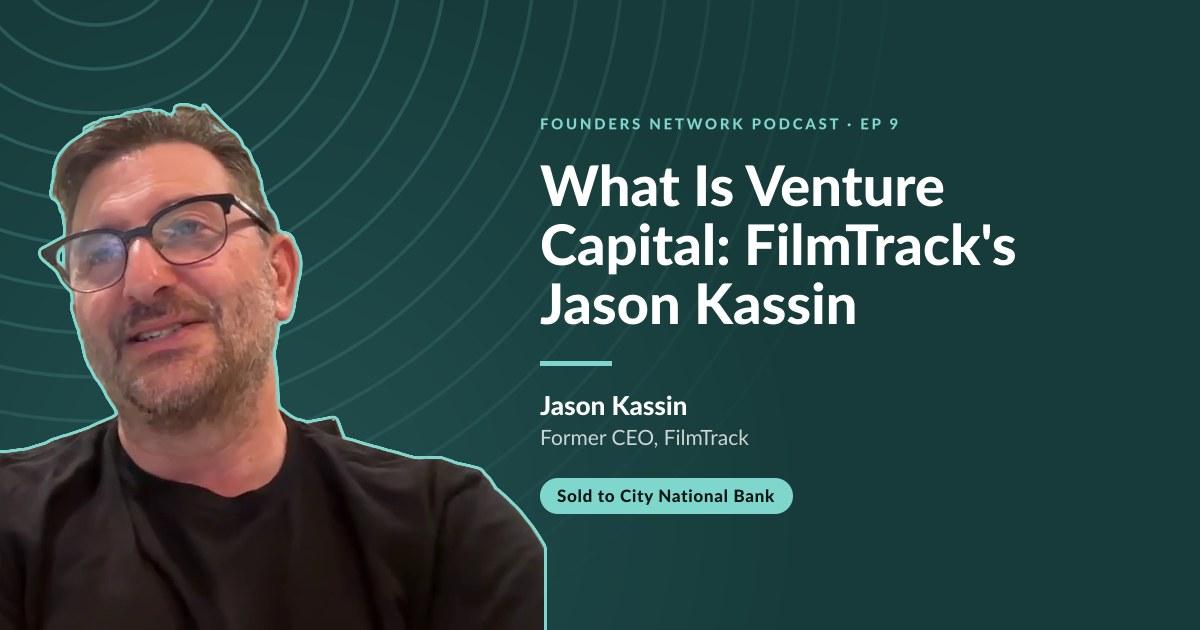
Venture capital is external funding that investors provide to high-growth startups in exchange for equity, typically before a company is profitable. Jason Kassin, co-founder of FilmTrack, spent 18 years building an entertainment rights management platform before selling it to City National Bank in 2019. His path included private equity from Insight Venture Partners, multiple acquisitions, and board members that included Sheryl Sandberg and the late Dave Goldberg. What he learned about capital, pitching, and persistence applies well beyond the entertainment industry.
Key Takeaways
- Time horizon: FilmTrack took 18 years from founding to exit; Kassin now tells advisory clients to expect at least six months before legitimate capital interest materializes.
- PE vs. VC: Private equity backed FilmTrack's growth acquisitions; Kassin's current advisory work focuses on Series A companies with positive EBITDA seeking $20M to $100M.
- Pitch quality: Deck and financial model errors are elimination criteria; people reviewing them see dozens daily and discard anything with typos, math mistakes, or AI artifacts.
- Competitive moat: In an era of AI and vibe coding, the defensible edge is increasingly the founder, the use case, and the architecture, not the code itself.
- Publicity tradeoff: Announcing a funding round loudly can create the market for competitors; Kassin says he would have flown under the radar.
What Is Venture Capital Funding?
Venture capital funding is equity investment from professional investors in exchange for ownership in an early-stage, high-growth company. Unlike a bank loan, it doesn't require repayment on a schedule, but it does dilute the founder's ownership and typically comes with board seats, investor rights, and pressure to achieve scale. It differs from bootstrapping (using revenue or personal funds) and from private equity, which usually targets more mature, profitable companies.
Kassin's own experience illustrates the distinction. FilmTrack's early growth was self-funded, using money he earned as a screenwriter. Only after the company had demonstrated its value at major studios did it attract institutional capital. As Kassin recounted on the Founders Network podcast, the confidence to raise came from an unexpected benchmark: a visit to Disney revealed that FilmTrack's system was more sophisticated than what a major studio had built internally. "I was like, Holy crap, 1986 called and they want their database back," Kassin recalled. That discovery convinced him that what he had built was likely best in class.
Private Equity vs. Venture Capital: What's the Difference?
Private equity typically invests in companies that already have revenue and positive cash flow, targeting operational improvements or growth acquisitions. Venture capital invests earlier, often pre-revenue or pre-profit, betting on market size and team. Kassin's FilmTrack drew private equity from Insight Venture Partners, not VC, because by the time outside capital arrived the company was already generating substantial revenue. The PE funding went toward acquiring three or four complementary companies and accelerating growth.
In his current advisory practice, Kassin works with what he calls post-revenue companies: Series A businesses with positive EBITDA that are looking for $20M to $100M to go from single-digit millions of EBITDA to ten-plus, either through an M&A transaction or by deploying capital into technology, marketing, sales, or new territories. That's a meaningfully different profile from the seed-stage company that might seek angel investors or early VC. Understanding where your company sits on that continuum determines which type of capital actually fits, and which conversations are worth having. For a broader overview of funding structures, startup investing and funding resources can help map the landscape.
How Long Does It Actually Take to Close a Round?
At least six months from first engagement to legitimate interest, before accounting for due diligence, negotiation, and close. That's the floor Kassin gives clients when they start a capital raise. "I've been with people who celebrate when they get their first LOI," he says, "and I'm like, okay, this is stage one of fourteen." The LOI is the beginning of a process, not the end of one.
FilmTrack itself took 18 years from founding (Kassin dates it to around 2001, when his wife told him she was pregnant and his agent warned of a strike on the same day) to the 2019 sale to City National Bank. That's an outlier in duration, but the underlying pattern is not. Capital sources take time to engage, the right strategic or financial partner takes time to find, and the processes themselves are long. Founders who treat a funding announcement as a finish line, rather than a starting gun, tend to be caught off guard by what follows. For more on what Series A fundraising actually involves, the mechanics are worth understanding before you start the clock.
What Makes a Pitch Deck Good Enough to Get Funded?
A pitch deck needs to be free of typos, math errors, and obvious AI artifacts before anything else. Kassin is direct: the people reviewing your deck see dozens daily, and anything sloppy goes in the discard pile before the story even registers. "It has to be at a baseline great," he says. That means the deck and the financial model, which he calls the two essential artifacts of any raise, need to hold up under scrutiny.
Beyond hygiene, the pitch has to tell a story, not just display numbers. Kassin's advisory work focuses heavily on refining that story, particularly for founders in entertainment, media, and the digital creator economy. A model that someone can hand back immediately because it has four math errors, or because the percentages are inverted, is a credibility loss that's hard to recover from. For founders building out financials alongside the narrative, the guide on mastering the pitch with financials and forecasts covers the mechanics in detail.
Kassin also makes a point about competitive claims. He hears constantly that a founder's engineers are the best in the world, or that nobody else does what they do. His response: "If they can do it in a day, there's a chance that someone else could do it in a day." The defensible moat in the AI era is increasingly the founder's specific insight, the use case, and the depth of the architecture, not the fact that something was built quickly. When a PE firm does technical due diligence, they will ask about microservices architecture, APIs, single sign-on, SOC compliance, and PII handling. That's process, not code generation, and it can't be vibe-coded.
Should You Announce Your Funding Round Publicly?
Not necessarily, and Kassin learned this the hard way. When FilmTrack raised its round, he made a point of publicizing it: articles in the LA Times, announcements, the works. In retrospect, he says he created the market for competitors. "Essentially what I did was I created the market for competitors," he told Kevin Holmes. The capital signal told the industry there was money to be made in entertainment rights management software, and well-funded rivals followed.
His advice now: unless there's a specific strategic reason to announce (recruiting, partnerships, customer confidence), consider staying under the radar. The claim that "nobody does what we do" is usually not true, and broadcasting your raise confirms to everyone paying attention that the category is worth entering. Know the competitive landscape before you tell the world you've found something valuable in it. This tradeoff between visibility and competitive exposure is one the fundraising mentorship conversations at Founders Network surface regularly among members who've been through multiple rounds.
What Does "Going the Distance" Actually Mean for Founders?
Kassin describes his core operating trait as ferocious stubbornness. He frames it as a superpower: when he starts something, he finishes it. That applies to bike rides (he does centuries, roughly 100-mile rides, about once a month), books, albums, and companies. But he's careful to distinguish adaptive persistence from maladaptive stubbornness. Holding the vision while updating the approach is productive. Refusing to change the approach as new information arrives is not.
His practical tool for navigating that distinction was something he and his brother called time traveling. When facing a major decision, whether to take a PE investment, which client to pursue, how to handle a product fork, they would ask themselves: what would we think about this choice if we were looking back from 10 years in the future? The exercise separates the pressure of the immediate moment, a lawsuit, a cash crunch, a difficult quarter, from the question of what actually matters over a longer arc. "What's the smart maneuver here?" was the question that mattered, not what the pressure of that week demanded.
The competitive implication of persistence is also worth noting. Kassin estimates that if 90% of founders don't finish or don't see a process to completion, the people who do are competing in a much smaller cohort. Endurance is itself a form of differentiation. That's as true for a capital raise as it is for building a company over 18 years.
What Kassin Got Right About Company Culture
FilmTrack ran over a thousand people through its doors across its lifetime, and Kassin says most of them call it one of the best jobs they ever had. He traces that outcome to two sources: his background in theater and improv, and the family business sensibility he inherited from his father, who ran a summer camp in the Catskills.
From theater came a "yes, and" ethos: the goal of every person in the room is to move the scene forward, not to present problems or score points. From the camp came a sense of belonging, mythology, and collective identity that outlasted the job itself. What he tried to build at FilmTrack was a team where the person who made other people better was the most valued person in the room, the same principle that applies in jazz, basketball, or ensemble theater.
Practically, that meant walking around and talking to every employee every day, not to check their work but to know them. It meant not being seen as a dictator, using a collaborative model he describes as more European than command-and-control. And it meant giving people room to breathe and think, with the understanding that lives are rarely on the line and that geologic time is a healthier frame than paycheck-to-paycheck anxiety.
He's concerned that the culture conversation has faded in recent years, partly because of remote work and partly because AI tools have shifted how some founders think about their people. "Your biggest asset leaves the office every night," he says, referring to the old maxim about employees. He wonders whether that mindset has shifted, and whether people are treating colleagues as necessary evils rather than the actual engine of the company.
What the Entertainment Industry Tells Us About Cycles
Los Angeles is experiencing a contraction in the entertainment industry that Kassin compares to what happens when a mill town loses its mill. Major mergers, reduced production, below-the-line workers not working, studios changing hands. The CBS lot he once had an office next to went through bankruptcy and private equity ownership before Netflix acquired it. The cascade effect reaches cleaners, restaurants, and car mechanics who served the tens of thousands of people who worked there.
But Kassin's read on cycles is characteristically long. He points out that Hollywood was supposed to die when AOL bought Time Warner in the late 1990s. A dial-up internet company buying a major studio looked like the future, until it didn't. The nature of content and how people consume it is changing, perhaps more fundamentally than the technology itself, but storytelling is not going away. The business model around it is what shifts.
His Soho House test is an informal proxy: go to a city's Soho House and observe the energy of its creative class. Amsterdam's is packed. Nashville's is packed. The LA one, he says, is notably quieter right now. That's not a mathematical metric, but it's an observation that tracks with what Founders Network sees in its own chapter activity in Los Angeles. Cities like London and Paris, which didn't overindex into a single industry, have shown more resilience in their downtown cores. Tokyo, similarly, maintained density through cycles that hollowed out comparable urban centers in the United States. For founders thinking about where to build and who to build alongside, those local conditions matter.
The underlying lesson from Kassin's perspective is that every technological transition, from mainframes to microcomputers, to the internet, to mobile, to cloud, to AI, looked like the end of everything before it. Each one was genuinely revolutionary. Each one created new companies and destroyed old ones. The founders who do well across transitions are the ones who stay on the surfboard waiting for the wave, rather than sprinting to the water only when they see it coming.
If you're building a tech startup, request an invitation to Founders Network.
Frequently Asked Questions
What is venture capital and how does it differ from a bank loan?
Venture capital is equity investment from professional investors in a high-growth startup in exchange for an ownership stake. Unlike a bank loan, it doesn't require scheduled repayment, but it does dilute the founder's ownership and usually comes with board rights and investor oversight. The tradeoff is capital without debt, at the cost of equity and control.
What is the difference between private equity and venture capital?
Venture capital typically funds early-stage companies before profitability, betting on growth potential. Private equity usually targets established companies with positive cash flow, often to fund acquisitions or operational improvements. FilmTrack, for example, raised private equity from Insight Venture Partners after it was already a proven, revenue-generating business, not at the seed or early VC stage.
How long should a founder expect a Series A fundraise to take?
At least six months from initial engagement to legitimate investor interest, before due diligence, negotiation, or close. Jason Kassin advises clients to plan for a 14-stage process and not to treat an LOI as a finish line. The full timeline from first outreach to funded can run considerably longer depending on the market and the complexity of the deal.
What makes a startup pitch deck good enough to get past the first review?
The deck and financial model must be error-free before anything else. Reviewers see dozens of decks daily and discard anything with typos, math errors, or obvious AI artifacts. Beyond hygiene, the pitch needs a clear story and financials that hold up to scrutiny. A model handed back because percentages are inverted is a credibility loss that's hard to recover from.
Should founders announce a funding round publicly?
Not automatically. Announcing a raise loudly signals to the market that the category is worth entering, which can accelerate competition. Jason Kassin says that publicizing FilmTrack's round in the LA Times helped create the market for well-funded competitors. Unless there's a specific strategic reason to announce, such as recruiting or customer confidence, staying under the radar is worth considering.