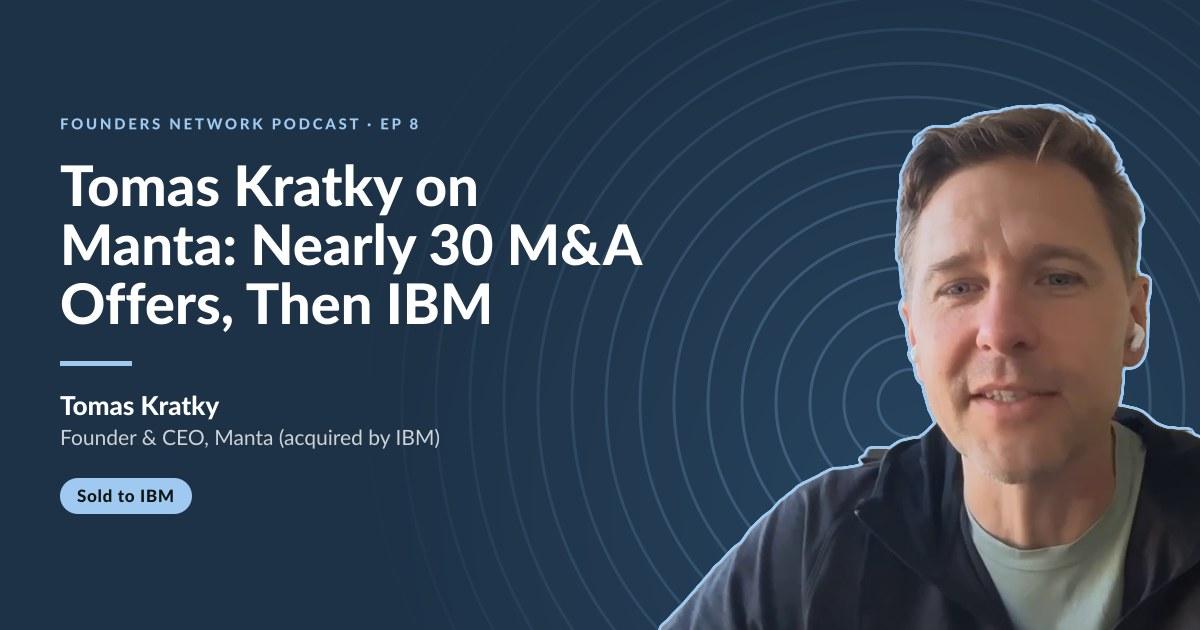
Kevin Holmes: All right, welcome everybody to the Founders Network Podcast. I'm Kevin Holmes, founder and CEO at Founders Network, GP of FN Fund. I'm here today with my guest, Tomas Kratky, founder-CEO of Manta, which was a leading data and lineage platform that helped enterprises understand, manage, and build trust in complex data environments. He grew Manta from a consulting project in Prague into a global enterprise software company. Of serving major organizations backed by Bessemer Ventures, Credo Ventures. And he grew it, expanded internationally, built strategic relationships around the enterprise data ecosystem until it was finally acquired by IBM in 2023. He's got over a decade of experience as a founder. So we're going to talk about how he navigated bootstrapping, venture funding, especially international expansion, enterprise sales. And the challenges of scaling from Europe into the US market. So hopefully we'll have a candid conversation about that journey, about building for acquisition, about partnering with larger industry players and balancing the demands of major customers with that long term product vision. Tomas is joining me in the San Francisco Bay Area, where he's a recent transplant. And so welcome to the Bay Area, Tomas. And it's great to have you here. I'm looking forward our conversation.
Tomas: Hello everyone and thanks for having me. It's a real pleasure always talking to you online, offline in any way.
Kevin Holmes: I yeah, hopefully more of more of that offline soon. so why don't we kick off with just kinda like you know, how did you what was your founder journey like and how did you first decide that you were gonna do this startup and you know, how'd you how'd you wind up where you are today, basically? Kind of take us through that at a high level.
Tomas: I would say like I keep thinking about that from time to time but people ask me especially like when you come from Czech Republic where being a founder like starting a company and going to the US it's like not normal yet for example compared to ecosystems like Israel or even like some other parts of Europe so people keep asking me I would say a couple things Thing number one, I was always extremely ambitious. So you just aim high, you do all you can, you always have big dreams. You sometimes don't know what the dream is, but you dream big. So that's one part. Second part, I was really fortunate to join an amazing company after my university. It was a very small software house back in Prague and that's where I met my friends. With my friends, we did management buyout, which was the first, like, not founder experience, like owning a company and growing a company from being a very small player to being one of the largest players in the region and serving customers in Czech Republic and in countries around Czech Republic. So that was exceptional experience and building on that, I was later able to first see the opportunity with Manta and then be, I would say ready to go for it. And also thanks to, having a very nice profitable company, we were able to invest some money into Manta in those early days and basically bootstrap it and get it. from the ground and eventually I got funding from Credo but that was much much later. combination of all those things was
Kevin Holmes: Mm, mm.
Tomas: what basically enabled the Manta story.
Kevin Holmes: It's interesting. So the first one you mentioned was ambition. Wh where did that come from? Is that from your parents? Was that just innate?
Tomas: For a long long time I had no idea but now I think it's just from my parents. Like
Kevin Holmes: Yeah.
Tomas: the way how they raised me, the way how they pushed me the right way. Not much cuddling was at home, more the opposite. Always like, you know, the son-father relationship, you always try to like impress
Kevin Holmes: Yeah.
Tomas: your father and he really doesn't care until you actually realize that he cares so much and he's so proud. But that's already too late, right? Yeah.
Kevin Holmes: Yeah, yeah. Cla classic Eastern European story. Yeah. Or or very classic of you know, globally actually, right? So that that drive, that's great. and then sort of stumbled into it with this this early kind of first job experience, I suppose, right? That exposed you to a sense of ownership.
Tomas: Yes, yes, it was like we had to borrow a lot of money from one of the banks in Czech Republic, signing, how you call it in English, like commissioning notes, basically like all your property, everything is there online. If you just screw it, then it's gone. So that was that like, balance of, I would say like obligations, responsibility, but at the same time, this like... excitement and adventure that's yours and you are building something that's yours and you are the ultimate decision maker. That was for the first time in my life actually having that experience and like I love it. just like I am actually not very good team player. I am very stubborn. I believe that I know the best and I want to do things my way so my friends they are like very I would say patient with me and they are also like older all of them so I don't know maybe that influenced their relationship but it was really amazing just living through that experience and very early in my life just learning how exciting it is. I think it's very different if you are in if you live in an ecosystem like here in the valley or I mentioned like Tel Aviv or Israel or London and you have 10 friends and eight of them are founders and two of them are early engineers in a very successful startup. So like that changes how you I think like see opportunities out there, how you think about your life, what you want to achieve. In Czech Republic, it's a different environment. It's getting much, much better, but it's still different.
Kevin Holmes: in terms of this probably resonates with a lot of founders around the world who will listen to this that are coming from outside Silicon Valley or Tel Aviv
Tomas: you
Kevin Holmes: or other tech hubs, New York City. Is it risk tall appetite for risk? Is it innovation, creativity, new ideas? Like
Tomas: Mmm.
Kevin Holmes: what what are the w how would you characterize that that culture that, you know, you're some sort of anomaly that you came out of?
Tomas: I think like risk appetite is definitely one of the key things. Like how much am I willing to risk? The other part of the same equation is like how big is my dream and can I even like, am I even able to dream big?
Kevin Holmes: Hm. Yeah.
Tomas: Because maybe I'm not, maybe I'm just like being raised in an environment where things are like great, nice, safe. I can get amazing money when I join a company, ABC, all of that. Again, very nice life. Just, just it's not like I don't even know what can be achieved if I give it a chance. So that's the, that's something I see a lot in Czech Republic, not like dreaming that way, not wanting
Kevin Holmes: Yeah.
Tomas: more, chasing dreams. It's very different. For example, here in valley, it's just the complete opposite. And that's exciting.
Kevin Holmes: Yeah, the put a dent in the universe kind of mindset. Yeah.
Tomas: Mm-hmm.
Kevin Holmes: Yeah, I've I've heard this actually from other parts of the world where the focus is on you know, and it's it's not necessarily bad or good, it's just different and and it's people will find their way where they want to fit in, but there's a culture
Tomas: Mm. Mm.
Kevin Holmes: of sort of work to live. And it's
Tomas: Mm-hmm.
Kevin Holmes: across the US too, different parts of the US. Silicon Valley,
Tomas: Mm.
Kevin Holmes: San Francisco is a little bit more live to work.
Tomas: Mm,
Kevin Holmes: And and more focus
Tomas: mm, mm.
Kevin Holmes: on your voc your calling, your vacation vocation, your impact, your career and ambition.
Tomas: I think it's also, I'm not sure like, I think the best way how to phrase this is do you actually believe that you can change the world? Like do you actually believe it? Are you just like waking up every day with that level of confidence that not like Jeff Bezos or Mark Zuckerberg or I don't know who like, but myself, I can change the world. And obviously it's much easier to believe it once you have that first success. Because like you see, okay, I was actually able to change like a substantial part of what let's say in my case, data management is. And I did it and it was actually not so like unbelievably hard. It was a lot of work, but it was not like impossible. And then you keep asking yourself, okay, can I actually do more? And, and, and, you know, have a bigger impact. So having that first experience that helps a lot, but I feel like in some parts of the world, like for example, here in Valley, more people believe it, even if they have no experience.
Kevin Holmes: Mm.
Tomas: And that belief is really important because you need to be naive in some way. You need to really deeply believe, be dedicated to the cause, just go and run through a wall if you need to. And I think for people, especially younger people back at home, it's really difficult. It's just like... The first question is like, why should I?
Kevin Holmes: Yeah. Yeah. Yeah. Yeah.
Tomas: Why me?
Kevin Holmes: Yeah, yeah. Yeah, so what you're saying like strikes me as you have to be naive. That seems related to ambition to me. Like those two things are related, right? Like
Tomas: ssss
Kevin Holmes: the ambition carries you, right? Like you it it's in in it overrides the the n the you know the reasons why should you and And I and not everybody has that problem to your point, right? Like w any
Tomas: Yeah.
Kevin Holmes: ev every population sample size, founders are outliers. They're you know, they don't fit in at large corporations typically, right? And they don't play well with others, right? And that's
Tomas: That's very true.
Kevin Holmes: why I chuckled when you mentioned that.
Tomas: Yeah, I still remember my first interview when I left the school was with like a really, really, really big bank in Czech Republic, one of those like European giants.
Kevin Holmes: Mm-hmm. Hmm.
Tomas: And like after the first interview, I just like, went home. No, this is not, this is not the place for me.
Kevin Holmes: A bank. Yeah, that's the epitome of yeah, conformity. so that's cool. So I want to talk about the I want to talk more about Manta. So you had this ambition to change the world. And you know, when you mentioned that I thought about HBO, Silicon Valley, changing the world through, you know,
Tomas: You
Kevin Holmes: compression algorithm, blah, blah, blah.
Tomas: Hahaha
Kevin Holmes: and a lot of people will will make fun of that, right? But what did that mean to you? Because it's a meaningful thing and it is what motivates people. founders is and probably if you're a founder and you're listening, it's getting clear on what motivates you, what you know, to im have impact, right? So a couple of takeaways already are the ambition and and and you know, being able to s you know, set your targets high. And if you're in a part of the world that thinks that's crazy, there's other parts of the world maybe that are more welcoming to that level of ambition. But yeah, I'm curious, W changing the world and having that impact like you mentioned i it's in the you know, the area that you did now works differently from the
Tomas: Mm-hmm.
Kevin Holmes: work that you put into it.
Tomas: Yeah, I would say like, for me, I think the fundamental thing was when we started, the norm for any, I would say development around data was that the level of sophistication is way, way... below what we were used to when let's say coding in Java or Python. And there was like really no reason for it. It was more like this is the high end stuff with the programming languages and software backend front end developers and whatever. And here we have data engineers and they're just like stupid. They don't know how to code and like they don't need like continuous integration and deployment. They don't need automated tests. They don't need, you know, change management controls, all these things. And one of the most fundamental things in any development is how you make changes and how you understand impact of those changes. And that was not available in data. at all. Like you touch a table and then you break millions of reports downstream because you don't actually understand dependencies in your
Kevin Holmes: Mm. Mm.
Tomas: environment. Which is absolutely not normal when you code in Java or Python because you have dependencies in your development environment directly and everything you know is marked by a red underscore color so you know it's it's it's wrong and you need to change it. So Like focusing on that experience and changing it completely and making, I would say data a better place. That was the fundamental driver for me. And it took me some time to realize that I can actually help everyone out there. Not just like
Kevin Holmes: Yeah.
Tomas: few people working for our customers, but we can go global and we can serve like thousands and millions of people potentially. We can have plenty of customers. All of that is possible because no one has it or no one can do it well. So that was one part. And second part, I was like, we had those first calls with, you you sell to enterprise companies. So the first thing you do is you set up a call with an analyst. Gartner, Forester, IDC, someone like that. So we had that first call with Gartner, it was maybe 2014 or 15, something like that. And like, that was a really bad call. Like a really
Kevin Holmes: Ha ha.
Tomas: bad one. And you know, like I felt for, I don't know, some, like a short period of time, I felt like very, like down. Okay, because they told me... this is nonsense, completely useless. You know, this is very old, not really, you know, there is no application of it for like more modern environments, all of that crap. And it felt really bad, but at the same time, I was really pissed and it was like another motivation. Like everyone
Kevin Holmes: Yeah.
Tomas: is telling you, this is either like this is not doable or this is actually like not really helpful, whatever, because people fundamentally don't believe that it can be done well, it can be done in a way to actually change how they do change management and incident management, whatever. And we had those first early adopters, first believers, and that was... like an infusion of energy every time we met them, because you see five people out there and they are really excited and
Kevin Holmes: Yeah. Yeah.
Tomas: you think like, no, I'm not crazy. Like these are
Kevin Holmes: Yeah.
Tomas: the biggest Fortune 50 companies out there and they are just like excited about finally having a solution. So no, I'm not crazy despite what everyone else says because I have the first proof that it's actually super useful and people are willing to pay money for it. like I think in like six, eight months we had this, I would say like a mix of very strong emotions in every direction
Kevin Holmes: Mm, mm.
Tomas: and that infused the... the growth after that and also like to boost the confidence eventually just living here for a few months and meeting people. We got PayPal as a first customer and you got that boost of confidence like no it can be done just like
Kevin Holmes: Mm-hmm. Mm-hmm.
Tomas: don't listen to people go for it go for it go for it just burn the bridges go for it.
Kevin Holmes: Burn the boats. So there's two things in there, right? And I hear it aga time and time again. The energy of customers fuels founders, right? Like if people are validating it in the market, and that's all that matters, there's gonna be all these naysayers or people who say this is this will never work. They they're always they're never gonna start something, by the way, those people. But But that's also fuel. That's also a source of fuel, right? And motivation for founders. so th I'm thank God for those people that gave you the like, you know what, I'm gonna prove you wrong. Like they really helped you in this
Tomas: Hmm.
Kevin Holmes: journey almost as much as customers saying, Yeah, this is really good. I like this. And the impact is that people treat data differently today in the industry. Software's eating the world. People miss this about technology, but it's a multiplier and it's a movement and it's this thing that's been unfolding since the beginning of civilization and go on and on. But like you're you've played it with with manta, with this experience. You played a role in, you know, in the industry and improving it. And the impact of that is everyone out there who's working with with data and and how it's managed and the stability and the things you mentioned. I wonder if you could share a little bit more about the Manta story and and make sure people listening really understand what that was about and the sort of the thumbnail sketch of that that journey.
Tomas: Yeah, absolutely. Absolutely. Absolutely. I think the essence first, what Manta really is. Manta is automated reverse engineering and analysis of your environment to really understand the flow of data and all dependencies in your environment. So you really can connect tables to reports. You understand every hop on that way, how data is transformed, what calculations you have or what calculations you do with data, how you merge data, all these things. So if you open the report and you look at number and you want to understand its origin you actually see it in a very detailed way and you can use that information for compliance reporting, for making changes in a safe way, for quickly finding a bug, all of these things and many many many many more. And the story of Manta is we built actually a few projects for a few customers back in Czech Republic. And then we realized they actually have all something in common, even though they were developed quite independently. And I was back then head of research relationship with universities and also products and marketing. And that gave me the opportunity to actually like do a project, research project with two local universities, work on that idea, get it more in, let's say, in more functional state. And then I was like almost pure accident, but we won like a local competition and had the opportunity to spend few months in Silicon Valley. And that was actually the... game changer for me because again, you come to SF and you know, you at least in my case, you question yourself. My English was really bad. You, I was not like a natural presenter. I was always like good with people, but not really like presenting to people standing on the stage and all of these fancy things. And I also like never was in sales. So new experience for me as well. So all of that together. You don't believe in yourself sometimes and just like having the or seeing
Kevin Holmes: Mm.
Tomas: the energy around how everyone is like half crazy. But at the same time, just like seeing that they are like all normal human beings and I'm still probably one of the smartest people in the room. You just like it. When I came back, I knew 100 % that we are spinning this off and starting a company and that was actually the beginning of the journey. With my friends it was really easy, we just split the company, split the shares, all of that stuff and then it took me some time to get the first money for the company from Credo and Senovo. And with that first money, I immediately went to the U.S. but I spent, I don't know, seven, eight years on the East Coast, mostly New York, because that's where all the customers are, like for us, big finance companies, big healthcare companies. So that was really, really nice. Learning how to sell, how to be persistent, how to do outreach, how to find product market fit, all of these things and many more. And we were doing really well, growing fast from, once we found the product market fit, the growth was really, really fast. We got Bessemer as our series A investor and then, because Manta was built as an ecosystem player since day one. So our capability was very niche, but it was an enabling capability for many other things. in data quality, data observability, data cataloging, data governance, data security and privacy, all of these things, you need to understand dependencies and data flows. And also having that enables you to present information in very different way and build completely new, I would say, user interaction patterns. And doing that for many many years the advantage of that was everyone was interested and over over time we got I don't know close to 30 &A offers it was like from the early days to late later stage and then the IBM offer came it was really nice and I liked IBM I still like IBM I think they are great people and it's a great company run by great engineers, maybe not so great salespeople, I don't know, but engineers
Kevin Holmes: Mm-hmm.
Tomas: are really exceptional. And then, I let them acquire Manta and spent another year and half learning how to do proper enterprise sales.
Kevin Holmes: Hm. Cool. Cool. Cool. so that whole saga was how
Tomas: 2015 till 2023. I would say like with my two years at IBM it was still 2025. So like 10 years.
Kevin Holmes: Yeah. Yeah, ten years. So ten yeah a ten year overnight success. Yeah, yeah. Cause w
Tomas: Yeah!
Kevin Holmes: we had talked about like one of the things that you perceive for founders is not underestimating the yes, have the ambition or naivety, whatever you want call it, that you can change the world. But the second piece is hard work, right? And time. And and that that was something we talked about in advance of like this is
Tomas: Yeah, yeah, yeah, yeah.
Kevin Holmes: something founders really need to understand and and we live in an age of incubators, accelerators, you know, cranking out hundred and fifty companies a quarter and founders or students dropping out of undergrad to go travel to go do these things and so there's a lot of almost like Unlike your s founding journey, there's a lot of founders that are entering the industry, call it, of startups, in a much more kind of transactional way, less organic in a sense. yeah, so I think there's probably some some lessons maybe that you could impart on your that I think are relevant for new entrants into the sort of startup land about how to think about this that are a key ingredient of your success.
Tomas: Obviously I'm like a testing set of one, which is never good enough.
Kevin Holmes: Yeah. N of one. Yeah.
Tomas: But I really deeply believe in hard work and sacrifice. I think it's just like, obviously there are exceptions probably, I don't know. But if you want to really achieve almost anything substantial, I think you need to put like a lot of very hard work into it and you need to live it. It's just like it must be your number one priority. I just can't imagine how you can just go through this, succeed, really achieve all the great things without dedicating your life to some extent to it. Obviously it's not the only thing you do, but very often it's like 99 % or 99.9. And yes, there is impact on your personal life, sometimes on your health, you need to balance it a little bit, but it's just hard work, a lot of hard work. And people keep saying these days like speed is everything, but speed was always everything. I remember one of the first team buildings or maybe the first all hands we did back in 2016. And I said, this is a sprint with the length of a marathon. And it's still true. And people keep saying that today as if it's something new, it is not, it's still the same thing. You need to move very fast and you need to keep moving very fast for very long time. You can be lucky, not lucky, but you can really hit the jackpot with your idea and you can execute very well. And if selling your business for hundreds of millions or maybe even billions like Coursor in this case is the outcome you want, it's achievable. But I don't know, it's maybe one out of 10 millions who can do it so quickly and so successfully. Most others, if you want to succeed, we need to work very hard for a very long time, compound and just like be strategic and build towards a vision, belief in that vision, maybe change the vision if you see the signals, whatever. But you need to have the persistence and most people don't understand what the necessary level really is, especially young people. Just like it's your first experience, you have no idea and it's not your fault, you can't know. The question is if you are ready to chew the glass and just keep chewing.
Kevin Holmes: Yeah. Or did you have moments where you were faced with chewing glass and sort of crucible moments where you were like 'cause it's one thing to work hard, right? Everybody can grok that the sprint part of it. but the marathon part of it, did you have moments where you just wanted to give up or you thought maybe the writing was on the wall and you
Tomas: Hmm.
Kevin Holmes: know, this kind of thing, or was it always did your trajectory sort of not map to that and was more of kind of an incremental or exponential or step function kind of?
Tomas: No, no, no, no, like we had, so we definitely had lot of dark moments.
Kevin Holmes: Mm.
Tomas: No question about that. Like we were close to bankruptcy multiple times. I remember, I think like probably the most difficult was just, I think it was maybe even like shortly before our series A with Besemer, because it was a culmination of many things with COVID. most companies decided to like slow down significantly. We experienced some churn and then invoicing got delayed extremely. Like companies paying in 30 days were now paying in 200 days. And obviously
Kevin Holmes: wow.
Tomas: you can just like, you have all the language in your contract, but you are
Kevin Holmes: Right.
Tomas: a small startup. What do you do if... you you deal with one of the top two or top three financial institutions in the US or the big telco or whatever, you can't do much. So you keep begging for money and it's everything for you and it's nothing for them. And that's the relationship. Anyway, so like combination of things and we were very close to like zero, zero. and company back then was already like decent maybe 60 people so you you it's not like you yeah yeah yeah yeah so it's
Kevin Holmes: wow. Yeah, a real payroll. Yeah.
Tomas: it's not like yeah there are five guys they will find a job i don't care suddenly it was lives of many people and also like money was running out really quickly and i was obsessed about getting like really top tier investor. Like for me, it was like Bessemer, Sequoia or someone like that. I had a list, very short, unfortunately. And that was the moment I was like really down thinking maybe I was so obsessed that I like killed the company because I had no plan B. I was just
Kevin Holmes: Mm. Mm.
Tomas: running against the wall again and again and again. And luckily for us, I mean, the wall went down, eventually we got money from Bessemer.
Kevin Holmes: It's great.
Tomas: But that was like one of those dark moments. And so I remember very often like feeling really down, but at the same time, I can't like, I am not capable of like giving up. when it comes to these things. It's just like, harder it is. It's just like, I don't know, I push more.
Kevin Holmes: Yeah. Yeah.
Tomas: So yeah, it was very dark, but yeah, never give up. Yeah, yeah, yeah.
Kevin Holmes: Never give up. Yeah. Yeah. Yeah. Well, it's interesting. I feel like there's in your case there you had this extrinsic event or external event with COVID that created a crisis of, you know, receivables. Today you have people there's a lot of FUD, a lot of fear, uncertainty and doubt around agencing coding and what that means on the future of SAS and SAS pocalypse and builders who are, you know, in the trenches like you were, and they're kind of getting a little bit overwhelmed with like, is this even gonna have a future? What are your thoughts on
Tomas: Mm-hmm.
Kevin Holmes: that? What what would you tell founders that are, you know, kind of wondering what's what's gonna happen here and if it's if all their efforts will be, you know, worthwhile
Tomas: Yeah, yeah, yeah.
Kevin Holmes: or not. Yeah.
Tomas: That's tough one. I mean, my English is not good enough to really express my thoughts now, but what I would like to say is that there are like two parts or maybe more, but like two big parts. Like one is how you get money because like you built your company, you need money. Maybe, maybe you do not because you can be profitable, but if you need money, it gets much harder, but it has nothing to do with your product, with your idea, with your company. It's simply because in my opinion, venture, like no matter what people say, what I see again and again is that in venture, you always like throw away the old thing and you always chase the shiny new stuff.
Kevin Holmes: Mm.
Tomas: And because it's the nature of how you make
Kevin Holmes: Mm.
Tomas: money. So
Kevin Holmes: Mm-hmm.
Tomas: does it mean that all SaaS is that? No, absolutely no. But if I'm a venture person and I have my dollars to deploy, I will always chase the shiny thing because
Kevin Holmes: Mm.
Tomas: if I do that, my chances to have someone else doing the next round is much, much bigger because that's where the focus is. That's where everyone looks at.
Kevin Holmes: The creative destruction. Yeah.
Tomas: So yeah, it's like the money part is absolutely like challenging because VC money simply goes elsewhere. But again, it has
Kevin Holmes: Hmm. Hmm.
Tomas: nothing to do with the company, the product,
Kevin Holmes: Mm.
Tomas: the chances to succeed, none of that. The only question is cash. Like, can you actually continue building using other forms of, or not other form, but... cash from other sources. That's, think, the fundamental question for most non-AI founders today. If I
Kevin Holmes: Mm.
Tomas: can get profitable, I know a few companies, really exceptional companies. They have not VC-type cap table, so they never
Kevin Holmes: Mm.
Tomas: had access to VC money. and you see them growing and expanding to the US and beating much better funded competitors.
Kevin Holmes: Mm.
Tomas: And like, I believe that some of those companies will be an amazing success in a few years,
Kevin Holmes: Yeah.
Tomas: even without VC funding, but they had to find other way to get money.
Kevin Holmes: This is such an important insight about the nature of venture capital and the dynamics of the venture capital industry, which are based on creative destruction. You know, you disrupt whatever you've just built in the last cycle and you capture that market. and at the end of the day, as you said, venture capital is just one type of capital in a capital strategy that has many types of capital, including revenue funding. And if you look at what motivates founders, as we kind of began our conversation in, it's not raising money, it's not why founders start companies, right? That
Tomas: Yeah.
Kevin Holmes: was that wasn't your vision, was like, I want to go raise money from Bessemer. It was a it was an approach that you adopted because of, you know, the time and place that you were doing this, but not your your what motivated you. So that's such a good point. I'd I hadn't heard anybody quite articulate it like that, despite your your disclaimer about your English language, the idea came across very clearly. Yeah, so I i I I think that also kind of points to this idea that, you know, keep building and don't make venture capital to be all end all and maybe what? Customer focus on customers and growing your business and at the end of the day like All SAS is not going away, right? I mean w would you w w
Tomas: No, but because
Kevin Holmes: yeah.
Tomas: I don't even like that, that categorization, how is SAS different? does it mean that 11 labs is not a SAS?
Kevin Holmes: Mm.
Tomas: it's SAS is just like the way how you deliver your software. so
Kevin Holmes: Yeah, yeah.
Tomas: I always force people to can you be more specific? Is it your pricing structure? Is it that your product? Yeah. So, or is
Kevin Holmes: Right. That's what SAS is, right? Yeah.
Tomas: it like your, because even Manta. Many, many years ago, we went through multiple cycles with pricing, experimenting, and we ended
Kevin Holmes: Mm. Mm.
Tomas: up using like usage-based pricing. No, no, it's like, because like, I
Kevin Holmes: Yeah. So you're ahead of the curve.
Tomas: think that happens if you stop thinking about labels and start thinking about your customers. Like
Kevin Holmes: Yeah. Yeah.
Tomas: the biggest, not the biggest, like there are so many mistakes, but most founders I talked to, They are not, they say we listen, but they don't really pay attention to what they hear. And they are, I was myself obsessed with myself, with the idea of why Manta is so exceptional. I didn't pay attention to what my customers say and how they see it, how they perceive it. Like what I consider very useful is maybe not useful at all. And maybe, and I can talk about Manta as an example, but it's very similar no matter what you are building. Like Manta, what we do, we connect things, we build a map and we help you understand, okay, that's great, but who is actually your user and who is actually your buyer? and how these big organizations are structured. Who is actually leading the procurement cycle? And is that the same person as the one using you or at least the same person as buying you or it's a third person. And like, then you see large enterprise company and you have like a data platform team, they are buying stuff. Then you have... business users, they are using stuff bought by the platform team and it's all approved by CTO, is completely or CDO, which is completely different organization. Sometimes by CFO or very often by CFO and they have very different. So it's not like a stakeholder game. It's even more complex. It's like you are selling to someone believing that they value the benefits you can deliver. But they
Kevin Holmes: Mm.
Tomas: don't because they will never experience those benefits. They are just buying the software and then they force other people in the company to use the software.
Kevin Holmes: Yeah.
Tomas: like, and like people, most founders, they don't think about like, my advantage is being a really good like systems thinker. So most founders, they don't do that. They just like, I talk to obviously way less people than you talk to, but Almost every fund that I talk to in five minutes, we are talking about this. Like, do you actually understand who you sell to? Do you understand if they have any benefit from using your solution? If they are even the user? And what's the relationship between buyer and user and who is your champion? And is your champion really your champion? like asking these questions and trying to be honest. Honest, not just lie to yourself about how exceptional you are, but being honest, seeing the gaps, seeing what's not working, seeing why they don't experience the value they should be experiencing. Like why it's not there, why you don't, why you can't deliver if on paper it looks so great.
Kevin Holmes: Mm.
Tomas: All of that happened to us and just paying attention to it. and responding to those signals,
Kevin Holmes: Mm.
Tomas: that's, think, everything that matters. Because like, everyone today is like, what's AI? It's just that you build your software differently, you have different user interface. If you are monday.com, obviously it's way harder for you to change everything you have built over the past 20 years. That's difficult. but most founders are not that. We changed the whole code base of Manta, almost the whole code base, at least twice. So doable, just, you need to be brave enough and not just lazy and afraid
Kevin Holmes: Mm.
Tomas: of making changes.
Kevin Holmes: Hmm. That's interesting. Yeah, I I think the one of the things we wanted to talk about was enterprise sales and lessons learned there. And every founder, you know, founders start with an idea and they have different points of departure as to how they become a founder. Usually that means different functional backgrounds. and many have to become product people or are product people and th and many have to learn and most all of them actually have to learn sales. And majority are not consumer startups. Majority are enterprise startups and majority have to learn enterprise sales. And there's countless, you know, books and methodologies and you know, seminars aro around enterprise sales and and and all this. And I just wonder if we could major on that for a bit. Like what what are what's the What's Tomas's distilled wisdom around you know enterprise sales for founders and maybe across different stages of the of the venture?
Tomas: It's actually... It's amazing question. I mean, I think the essence of what I have learned is that all these methodologies and frameworks and everything, they are super useful in showing you what are the questions to ask. And there are like few fundamental questions. I don't know, six, seven, maybe. It's not so hard. It's not rocket science. I think I know that the real challenge here is not the framework or if one methodology is better than the other one. It's actually the discipline to be honest and to truthfully answer those questions and not be afraid of the response. Because like most founders, for most founders, I think it's so hard to admit that what you see as so exceptional is actually not exceptional at all. And, you know, from many reasons, it has nothing to do with technology or how the product is built or how smart and cool the idea is. It's just like how you can implement it in a real world. with a lot of limitations and with a lot of politics in those companies with different object. Like I met a founder recently and they were just like complaining about a few deals and how they use MedPic or something like that. And like it's clearly a very good opportunity and they should spend more time on it. And then we spent like, I don't know, five minutes. talking about the key questions like who is the buyer and what's the ultimate reason for the buyer to give you money? What are other things the buyer can do with the money? And then like the guy said, like, why, like, why should I think about other things the guy can do with the money? I have no competitors there. I think everyone is your competitor because it's not about the money. It's about the company being able to do one new thing in 2026 and that one new thing should be worth it. So maybe it's 500 mil migration project to the cloud or it's 200 mil big revamp of the analytics layer and implementing AI interfaces. That's the type of thinking. And if you are not part of the stream, no matter how good your idea is or how good your solution is or what's your ROI, TPV, all of these things, you are down on the priority list. Find those customers where you are the number one priority or you
Kevin Holmes: Yeah.
Tomas: are very well aligned with what the number one priority is
Kevin Holmes: Mm-hmm.
Tomas: and you substantially change how they can succeed with that priority.
Kevin Holmes: Yeah.
Tomas: find those customers, that's where you can sell. It's
Kevin Holmes: Mm.
Tomas: not about, you know, like anything else basically. So not being honest, not answering those fundamental questions honestly and truthfully, and just closing your eyes, putting your head in the sand, that's
Kevin Holmes: Mm.
Tomas: what I see 99 cases out of 100. And that's why
Kevin Holmes: I love it. Yeah.
Tomas: we struggle with enterprise sales.
Kevin Holmes: Yeah. So technology in search of a solution, right? You're you've built something,
Tomas: Yeah, yeah, yeah, yeah.
Kevin Holmes: you've probably held on to it too long and not shipped early enough, and by the time you get out there, you have no bearing on what the market's actually thinking about or what they actually are their goals and objectives and how you might intersect with that or enable that. Yeah. What was it what's that process
Tomas: Exactly. Yeah. Exactly. Exactly.
Kevin Holmes: like? Are you are you is it just a process of discovery, of getting conversations with people and The right org size
Tomas: I mean, I f-
Kevin Holmes: department title.
Tomas: Yeah, I mean, I found myself that is actually very easy to ask. You just meet a lot of people, you ask the same question or variants of that question, and you just make logical conclusions and you ask the next best question. And you don't accept half answers. Like... It happened to me with our salespeople, some of them, I see it with some other founders, how they struggle when they hire the first salespeople or even like founders themselves. You ask someone, they give you an answer and you just take it without even thinking if the answer is like coherent and if the answer actually makes sense. And if you really understand every nanometer of that answer, because like Very often people say something, but they don't say 99 % of stuff and you need to dig deeper and dig deeper and dig deeper. And people are afraid of that. Very often I hear founders saying, but I don't want to like offend them. It's like, no, it's curiosity. Just present it
Kevin Holmes: Mm-hmm.
Tomas: as a curiosity. That's your like, that's your best read. Just keep asking because you... you care about their business because you want to understand, you want to deliver the best possible solution that would help them. So keep asking questions. Just don't accept the shallow, you
Kevin Holmes: Mm.
Tomas: know, yeah.
Kevin Holmes: Or is it ask why, you know, seven times or something, right? And I keep keep driving, yeah, yeah, yeah.
Tomas: Yeah, yeah, yeah, yeah, yeah. And really just good example is in our case, Manta. So you are talking to a prospect and they reach out, so it's inbound, very often inbound. And they, you talk to them and they, and you ask because you already know that if they don't have a good enough reason, if it's just like a research, it makes no sense to waste time with them because you
Kevin Holmes: Yeah.
Tomas: have 50 other better deals to focus on.
Kevin Holmes: Yeah.
Tomas: So you ask like why and they say, yeah, because we have this like bigger governance initiative. And then some people accept it. I would never, say like, but governance means nothing. Like what exactly is the challenge you are trying to solve? And maybe they say something like, yeah, it's mostly driven by this GDPR stuff. And you say, yeah, but it's still like means nothing. So what's the reason? Was there a fine you got? Is it that you are trying to mitigate the risks? Or like, tell me more. And then you just like dig deeper because maybe what you learn is that Everyone is talking about GDPR so someone and that company says to someone else please take a look into this and research solutions that could help us and we will maybe eventually implement something but also maybe not because we are already using Microsoft. Microsoft has like a half good solution so it's a good checkbox we can show it to our regulator and we are good and golden and we don't need to do anything.
Kevin Holmes: Mm.
Tomas: you need to understand the detail to decide
Kevin Holmes: Mm. Mm-hmm.
Tomas: how to proceed and if it's a good fit or not. Yeah.
Kevin Holmes: Hm. Yeah. And we have a lot of listeners who are listening to this conversation. Founders in the very earlier s early stages, sub million revenue. I would imagine and and they're they're wondering about how to build this flywheel and how to get going to where you get to having payroll problems with sixty employees, right? and and so with those first customers and those first conversations, and then I'd imagine with you a lot of it was from the services side, you had some of these relationships perhaps. But at some point you started sourcing, or maybe from the beginning as you're shaking your head, you had to go cold. what was that?
Tomas: Yeah, yeah, it was, yeah.
Kevin Holmes: Yeah, yeah. Like help help guide the listeners on like how they could think about that jump starting that process.
Tomas: Yeah, again, some people say I'm wrong. I just deeply believe that you just 24-7, you do nothing else but you reach out to customers and you schedule as many in-person meetings as possible. Like when I see a founder selling to larger enterprise companies over Zoom, I
Kevin Holmes: Mm.
Tomas: just like... Just go home, go home, find better things to do. You can't succeed. The second thing is people say, yeah, but we have so many other things to do, so many other responsibilities. Like if you don't sell, nothing else matters. So like first start selling and then you can deal with the other important stuff.
Kevin Holmes: Hm. Did you ever hand off sales or did you were you always involved for the ten years? Yeah.
Tomas: Yeah, yeah. I originally, it was me living in New York and just like every day hitting the streets and trying to meet as many people as possible. And I was relentless, just like sending emails, sending LinkedIn messages, just like doing whatever I can to meet the people. And back then people responded. They were like interested. Also being a founder helps you because it's still slightly different than meeting a head of sales or someone like that. So that was one part. And then the trap for me or the mistake, the big, big, big mistake I made was having no experience, basically like hiring a salesperson and letting them run and losing the touch.
Kevin Holmes: Yeah.
Tomas: The idea was, yeah, they can generate leads and then I can close them.
Kevin Holmes: Mm.
Tomas: It was not working at all. And we lost a lot of time, maybe almost like a year, I would say, till I realized that we still don't have product market fit and the sales guy. I mean, I don't want to send the wrong message. If you hire a really experienced salesperson, they can help you to put structure in how you operate, like how you run CRM, how you do pricing, what's the good language to use when talking to maybe some higher execs and all these things, it's very valuable. But I think you must be involved, it must be you doing most of the work, at least till you really crack it.
Kevin Holmes: owning the process end to end so that you have the the tacit sort of feel for what's working not working.
Tomas: Yeah, yeah. And things are changing so quickly. Like, do you really want to have your insight filtered by someone you hired six months ago? And that someone has no idea what your vision is, like no true idea what your vision is, what you are building, like how you can outsource that? It's
Kevin Holmes: Mm.
Tomas: just, I don't know. I don't believe
Kevin Holmes: Yeah.
Tomas: that.
Kevin Holmes: Yeah. I mean, I think what makes a founder of founder is maybe an obsession as well, right? It's the obsession with the problem and the approach and the solution and iterating. And if you lose that very vital context in the very beginning, it sort of neutralizes neutralizes you, and especially as things are changing so fast, even more so. I wonder so we cover a little bit of of the enterprise sales side of this and you know, diving headlong into it and just making contact in person with the market. I definitely see that with the Founders Network Fund portfolio founders, the ones that are getting on the plane. in this case enterprise sales, they're the ones that have the best updates every month. in terms
Tomas: Mm-hmm.
Kevin Holmes: of revenue, new logos, this kind of thing. So I I still believe in that. I still believe that's true. People buy from people and You know, I I think that's I think that point is super important for people to take from this.
Tomas: And also, I think, especially like different reasons in different locations. When I talk to people in Czech Republic, very often they are just like too comfortable. Like, I don't want to leave my golden cage, I love it here, why should I just put
Kevin Holmes: Yeah.
Tomas: myself, blah, blah, blah. They never admit that, but that's the real reason.
Kevin Holmes: Mm-hmm.
Tomas: That's one case. Then the other case is you live here in SF and you are in bubble and you feel like exceptional and then everyone else is talking about the topic you are interested in and it's like really a bubble. And then, I mean, maybe your customers are manufacturing companies or oil and energy companies. Like why are you in SF? Like you should be in Texas or you should be somewhere else because they are there and you need to meet them. So for example,
Kevin Holmes: Where the buyers are. Yeah.
Tomas: I invested in like amazing two person company. It's very early and they are just changing how oil and gas and some other similar industries, how they operate when it comes to safety procedures. And after like incubating the company, they are already moving to some hidden place in Texas where all the
Kevin Holmes: Mm.
Tomas: big oil and gas companies actually are. So like that's what you want to see, just
Kevin Holmes: Hm. Yeah.
Tomas: people going for their customers, living with their customers. How you can actually learn anything,
Kevin Holmes: Mm.
Tomas: not spending all the time you have with real experts, which are your customers. And also, by the way, they probably don't talk about the same things. They don't even like, they don't maybe even care about AI. I don't know.
Kevin Holmes: Mm.
Tomas: Maybe they talk about very different topics and maybe AI is the technology to implement that, but it's not the surface. It's, that's what makes the SF bubble really difficult. So going out, expose yourself, be with your customers. 24-7, I think that's the way how to start.
Kevin Holmes: Yeah, everything you're talking about just reminds me of how in Silicon Valley we get we fall in love with the technology. And there's a discipline in moving off of the solution and and coming back to what's the problem. And to do that, you have to be this forward deployed engineer. You have to be Yeah. Yeah. On on
Tomas: yeah, like that. Yeah, yeah, yeah, yeah, yeah, exactly, exactly.
Kevin Holmes: site with the customers. I wanna talk about what's next, because you've recently relocated to the Bay Area. and you know, you've you've you've got you're not done yet, right? You've got you know, you mentioned investing in a company. what what's keeping you busy these days and and you know what what are you finding interesting?
Tomas: I mean, one part is that I work with a few startups quite closely, just advising. I am an investor. I backed a few, maybe 10, 11 companies, something like that. I also work with very small GPs, so 10, 20, 30 millions. I like that, like. edge that very early stage no matter if it's a startup or a fund. that really, I mean I keep learning so much working with this group of people. It's everyone is so smart, so in something and that's amazing. So that's one part and also like I keep saying my non-compete is going to end soon. and I am already thinking what's next. So I'm really interested in physical and not robotics, which is physical like the old industries. I love
Kevin Holmes: Mm.
Tomas: manufacturing. My father was building the
Kevin Holmes: Yeah.
Tomas: first power plant in Czech Republic, so energy was always close to my heart. We had a lot of heated discussion about the topic at home.
Kevin Holmes: Mm.
Tomas: So I see a lot of structural issues, as many other people. And I just want to be part of the wave, just fixing that and just moving us forward. I'm excited about that. So not sure what exactly it will be, or I don't want to like disclose everything right now, but that's the direction I'm heading. That's what excites me.
Kevin Holmes: Okay, so T B A, and boring boring industries is the yeah, yeah.
Tomas: Yeah, I love boring, by the way, I love boring. Manta was boring, selling to boring industries, everything boring is exciting.
Kevin Holmes: okay. And you live here now and you mentioned everyone here is half crazy, so you now are officially half crazy. You found your tribe. That's great great to hear you're enjoying the energy. Yeah.
Tomas: Yeah, I am, absolutely. Just, you know, like moving to this place where for rent you pay for the same as the whole year of living somewhere else, you must be crazy.
Kevin Holmes: Yeah. Yeah. I think it's it's a s self selecting group in a way.
Tomas: Haha.
Kevin Holmes: we've talked about I wanna kinda get through like some rapid fire stuff. We talked about international founders contemplating you know, moving to the US. Any kind of key ideas to to provide to that odd part of our audience of whether they should do it, when they should do it, how they should do it.
Tomas: I mean, I think like the very short answer is if you are enterprise B2B solution or company, there is no better place in my opinion than United States for multiple reasons. First, you have so many people speaking the same language. You have quite uniform markets, even though California is different from New York and from Florida and from Texas. Like yes, but it's very uniform compared to Europe, let's say. And most of the really interesting companies are here. Like all the big banks, almost all the big banks, big healthcare companies, big telco companies, big technology companies, everyone is here. what's there, there is not a better place unless you do something really specialized. or you can really use the advantage of some very special local ecosystem. So maybe you are building quantum and it's better for you to stay in Munich or in Zurich or I don't know, like there are places where you maybe can do better initially, but in most scenarios I say go, go, go, go, go because here is the only place where you will be really tested, like really pressed and pushed and squeezed and tested. And if you do that very early in your journey, you have much better chance to actually succeed and build something fundamental
Kevin Holmes: Mm.
Tomas: and big because you will be ready for the fight. If you come too late, you will be lazy and you will be like demolished by... companies in the US.
Kevin Holmes: I love it. the the the pressure testing of of the the US market. and y you know, you mentioned Sprint and Marathon, kind of keying off of that. it's a lot of energy to do that, to come here, to hit the pavement, have the conversations. There's a lot of sacrifice personally to to go ninety-nine percent into something, but yet you have to do it in a sustainable way. What's one thing that you would give advice to founders to not sacrifice on the personal front? Like what would you protect in order to be able to sustain this effort.
Tomas: I mean, it's so hard. Maybe, I mean, I don't want to like, I would say steer people in the wrong direction because everyone is different. But I found, like if you think about really exceptional athletes, like F1 drivers or like everyone who is extreme, like what you see is that everyone is so obsessed with their health, like how fit they are, how mentally fit they are. and they ignore everything else. Like they give up on life basically, but they stick to the routine. Like they train and they just do something with their head. And I think one of my mistakes was not doing that for some time and I paid the price, but I was able to just get back on the track. I think that's the most fundamental thing. If people look for I don't know, fun and easy life, know, being a founder is not that. For me, it's really more like a F1 driver.
Kevin Holmes: Mm.
Tomas: You sleep, you eat, you work and you train and that's it. And then you have the adrenaline and the excitement of the fast drive. and you live from that, from that excitement and you are chasing something and that's why you live. If you want more or something else, I think you should just very, very, very, very deeply think about what's the right career path for you.
Kevin Holmes: I think that's a great note to to wrap on. it is like being a high performance athlete and
Tomas: Yeah.
Kevin Holmes: it is a marathon. You gotta get I always talk tell my kids about the fundamentals, diet, sleep, exercise, and social. I think having some piece of that that's re renews the spirit is good and we're we're social creatures. So that's why we have a network at founders that work of other founders who are also half crazy that you can commiserate with and yeah.
Tomas: I actually agree with this a lot and I really appreciate what you are doing and what some other people do. Just bringing founders together because I think at some point as a founder, some say it's four years, some say it's two years, doesn't matter. But at some point, no one understands you. No one. Your wife, your girlfriend, your partner, your friends, they don't understand you and you stop talking to them basically. because like you talk to them, but there is no value, is no social cleansing. But if you can like talking to another founder is almost like therapy. You can't replace that with anything.
Kevin Holmes: Yeah, it people say it's cathartic. yeah, yeah, yeah, yeah. Cool.
Tomas: Yeah, yeah, yeah, yeah, yeah, yeah, yeah.
Kevin Holmes: well good. Well Tomas, thank you for spending the time being on the Founders Network podcast. Thanks for being part of the group. welcome to San Francisco Bay Area, Silicon Valley. It's good to have you this side and look forward to many more conversations to come.
Tomas: Okay, thank you very much for English fun and I'm always ready to do the next.
Kevin Holmes: Sounds good. Thanks again. Bye-bye.